
Central African Republic and Russia Expand Economic Partnership as First Intergovernmental Commission Meets in Bangui
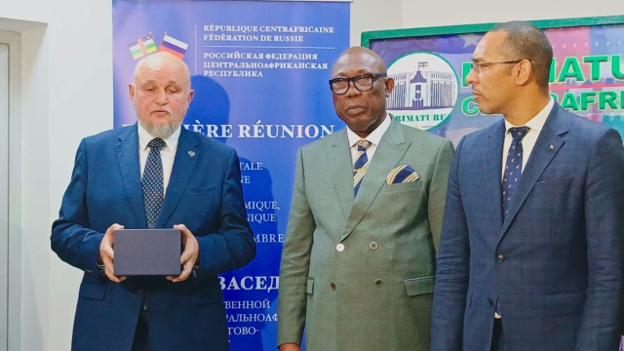
The Central African Republic and Russia are expanding their bilateral relationship into a broader programme of economic and technical cooperation, following the first session of their Intergovernmental Commission on Trade, Economic, Scientific and Technical Cooperation in Bangui. As Radio Ndeke Luka reported on October 1, the September 30 meeting brought together senior officials from both countries and concluded with the signing of several agreements aimed at consolidating bilateral relations. The Russian delegation was led by Energy Minister Sergey Tsivilev, while the Central African side was headed by Economy, Planning and International Cooperation Minister Marc Mandaba. Russia’s Ministry of Education confirmed that the commission brought together government officials and representatives of business and technical sectors, marking the first formal meeting of the new mechanism in Bangui.
The discussions covered a wide range of sectors extending beyond the countries’ existing security relationship. According to African Initiative, around 140 Russian representatives from government and business participated in the commission, where both sides identified priority areas for cooperation. Energy featured prominently, alongside geology and mining, transport, education and other areas of economic activity. Russian transport officials have also outlined potential cooperation on developing the Central African Republic’s transport system, modernising airport infrastructure, supplying equipment and training Central African specialists through Russian universities, according to a report citing the Russian Ministry of Transport. In education, Russia’s Ministry of Education said the two sides discussed establishing a school in the Central African Republic where instruction would be conducted in Russian alongside the country’s national educational content, while cooperation with the University of Bangui was also discussed.
The breadth of the commission reflects an attempt by Bangui and Moscow to institutionalise their growing partnership through concrete economic projects rather than leaving cooperation concentrated in one sector. The meeting comes as the two governments are also discussing energy development, including cooperation around nuclear energy, while the new intergovernmental mechanism provides a framework for identifying and advancing projects across several productive sectors. The Russian side has said the commission is intended to create practical conditions for deeper commercial and technical cooperation, while Central African officials have emphasised the need to remove obstacles facing investment and joint projects. The first commission therefore marks a significant institutional step in the relationship: from individual agreements and diplomatic exchanges toward a structured mechanism through which the two states can coordinate projects in energy, natural resources, infrastructure, education and technology.





