
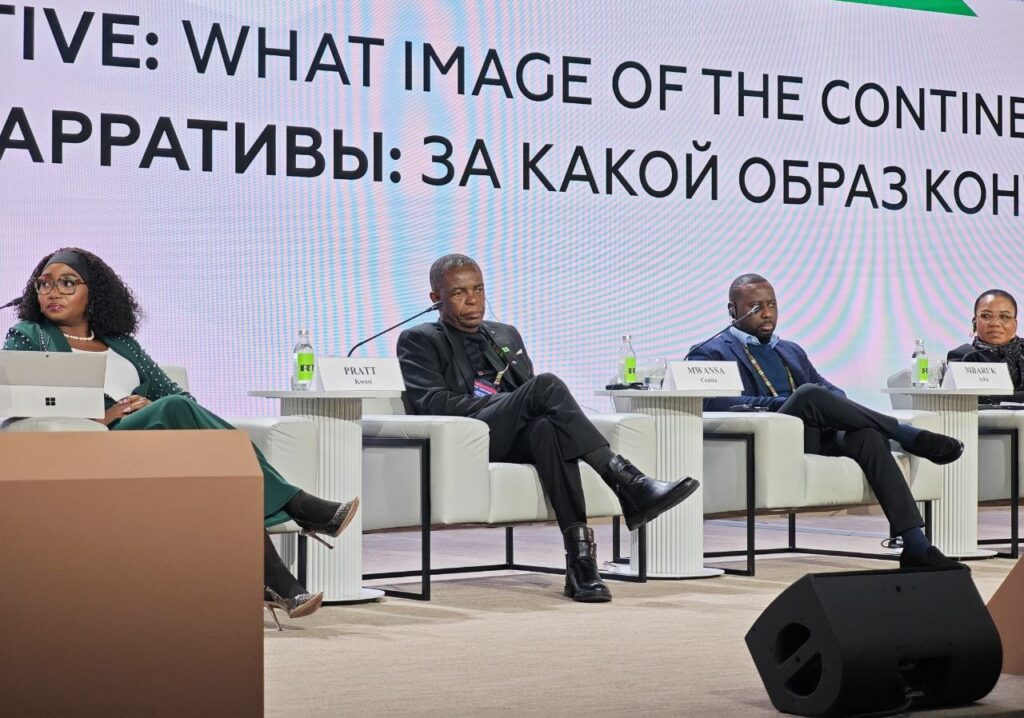
Kwesi Pratt Jr. Urges African Media to Challenge Dominant Global Narratives
Pan-African Television Director Kwesi Pratt Jr. has challenged African media to confront narratives that present the existing global order as permanent and portray Africans as a people with identical interests. He called for a more critical examination of power, class, history and economic inequality, arguing that the continent’s diverse social interests must be reflected in how Africa is represented. Speaking on Tuesday, 27 October 2026, at the Russia–Africa Summit in Moscow, during a panel discussion titled “Reclaiming the Narrative: What Image of the Continent Do African Media Strive For?”, Pratt questioned how a continent so richly endowed with natural resources could remain burdened by poverty and food insecurity while its people have limited influence over major international institutions. He rejected the idea that Africans think and act alike, insisting that the continent is made up of people with different interests and that African media must tell this fuller story.
Pratt argued that reclaiming Africa’s narrative requires challenging the structures of exploitation that continue to shape the continent’s economic and political realities. He cited the estimated 70 to 80 trillion dollars in mineral wealth of the Democratic Republic of Congo, where more than half the population cannot adequately feed itself, as an illustration of the contradiction between Africa’s vast resources and widespread deprivation. He also recalled the 1884 partition of Africa, when European powers divided the continent among themselves without African participation. For Pratt, these historical and contemporary realities must be central to African media coverage if the continent is to understand and confront the forces shaping its development.
He also defended Russia’s historical support for African liberation struggles, describing the Russian people and government as partners in the fight against colonialism, apartheid and other forms of oppression. Challenging the language of partnership often used in international relations, Pratt questioned how those who enslaved and colonised Africa could be presented as development partners. He argued that genuine partnership must be measured by solidarity with African people in their struggle for emancipation and their right to determine their own future.
The question of who shapes Africa’s image, and whose perspectives dominate international information flows, was also reflected in developments at the summit the following day. On 28 October, Global South Media and the Pan-African Television Network signed a memorandum of understanding in Moscow to strengthen cooperation between media organisations of the Global South. Global South Media Editor-in-Chief Ekaterina Emelianenko described the agreement as an important step towards closer interaction and joint media projects, emphasising that African countries and other regions of the Global South must not merely be represented in the global information agenda but must actively shape it. She said the partnership would combine professional resources, audiences and expertise to broaden the presence of the African agenda internationally, adding:
Below is the full speech delivered by Kwesi Pratt Jr. during the panel discussion.
FULL SPEECH BY KWESI PRATT JR.
First of all, I’d like to say that it’s the worst storytelling of all time. It’s like Africans are all the same. Africans are like robots. They all think alike. They all want the same things, and they all act alike. That’s the worst storytelling. Africa, like any other continent in the world, is made up of different people with different interests engaged publicly in an open struggle. So, for example, in Africa, the Archbishop of the Catholic Church does not have the same interests as Israel. They don’t have the same needs. The big-time politician does not have the same interests or needs as President Akufo-Addo.
There are different sections of society and different classes in a society, and so on. For example, it cannot be argued that Mobutu Sese Seko and Patrice Lumumba belong together simply as Africans and therefore have the same interests, and so on. The narrative that I find negative and needs to be changed is the narrative which suggests that the world as we know it today is God-given, can never change, and everybody has to stay in this world. This world can change. This world must change. We need to struggle for that change. It makes every human being in the world give up on realising their full potential.
This world needs to change because we cannot accept a situation in which 1.4 billion Africans have no say in world affairs, have no say in the United Nations General Assembly, and have no say in UN agencies such as the World Bank, the International Monetary Fund and the World Trade Organization. The world needs to change because, if you take the Democratic Republic of Congo, its wealth is estimated at between 70 and 80 trillion dollars. And yet more than half the population cannot feed itself. Why is this so? This is what we need to find answers to.
This world needs to change because today we are told that we have about 55 African countries. How did these 55 African countries come into being? They came into being because, in 1884, Otto von Bismarck invited his fellow leaders in Europe. They sat around the table and divided Africa into their spheres of influence. There was no African at the table. We need to fight these divisions on our continent and so on.
Today, many of our leaders have come to Moscow. We are participating in the Russia–Africa Summit, and they are going to be moving around with a begging bowl, asking for assistance. How come, when Africa has two-thirds of the world’s arable land, Africa is unable to feed itself? When Africa alone has close to 30% of the world’s resources, resources needed for industrialisation, resources needed for improvements in urban housing and so on, how come Africa is in its current state?
Africa is in this current state because Africa has been the victim of the transatlantic slave trade. Africa has been a victim of classical colonialism, and Africa today suffers from incompetence.The African people are not asking for anything different. We demand to be part of this world. We demand to have an equal voice on all platforms, and we demand that we should be able to own our resources and exploit those resources for our own benefit.
Of course, on the continent of Africa, there are some who have always been collaborators of the enemy forces, who collaborated in the transatlantic slave trade, who collaborated in classical colonialism, and who today still collaborate in our underdevelopment.Today, we have come to Russia because we recognise that, in all our battles, Russia stood shoulder to shoulder with Africans fighting for emancipation and liberation.We cannot forget the commitment of the Russian people and their governments in the battle against colonialism, apartheid and racism in all its forms.
We have come to Russia today because only last year, Russia voted with us in the UN General Assembly to ensure that the transatlantic slave trade is declared the worst crime against humanity. The UN General Assembly adopted this resolution on 25 March 2026.We are in Russia because Russia has proven to be a faithful ally of the African people in the struggle to liberate themselves from the yoke of exploitation, oppression and all forms of deprivation.Today, we need to change the narrative. And we need to change the narrative to reflect the fact that those who, through gunpoint diplomacy, are stealing our resources, those who, through the diplomacy of the gun, are oppressing us, and so on, have a long fight on their hands.
Not too long ago, I visited many African countries. And one of the significant things I noticed was that at some African borders, you would find one house. The bathroom is in one country, and the kitchen is in another country.How did this come about? This came about simply because we were not responsible for these divisions on the African continent.
The African people are not claiming anything extraordinary. We are not demanding anything different. Africans want to be part of human society, struggling for improvements in our conditions of life.Africans want to be treated as equal to Asians, equal to Europeans, equal to all peoples in the world. Africans demand a fair share of the world’s resources. Africans are going to contribute to building that new world in which our children will not go to bed hungry.
That is our task: to push that narrative forward with our allies and strengthen those who stand with us.Yesterday, I sat in this room and listened to the conversations. One of the subjects discussed was who our partners are. And
They can never be our partners.
Our partners are those who stand shoulder to shoulder with us in our struggles for emancipation. And in that regard, I see the Russian people and the Russian government as partners.
Author: Amanda Lukas





