
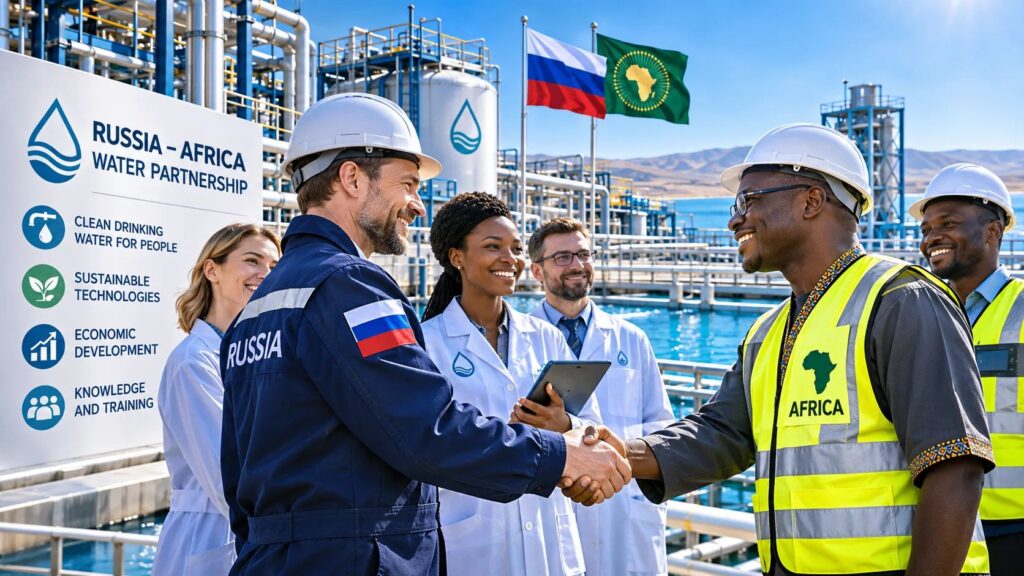
Water as a Strategic Resource: Russia and Africa Discuss Joint Technologies to Address the Water Crisis
Access to clean drinking water, the development of water treatment technologies, and adaptation to climate change were the central topics of an expert discussion held on October 29 in Moscow, on the sidelines of the Economic and Humanitarian Forum as part of the Russia–Africa Summit. Representatives of the scientific community, government institutions, and businesses from Russia and African countries discussed the need to move beyond political declarations towards practical technological solutions.
The roundtable, dedicated to the socioeconomic and technological dimensions of water security, was moderated by Irina Abramova, Director of the Institute for African Studies of the Russian Academy of Sciences.
One of the key presentations was delivered by Yvonne Libona Bonzi-Coulibaly, Permanent Secretary of the National Academy of Sciences, Arts and Letters of Burkina Faso. She emphasized that Africa’s shortage of clean water is driven not only by geographical and climatic conditions but also by political factors. Among the major obstacles, she identified the reluctance of Western countries to share essential technologies and insufficient coordination among African nations themselves.
From Political Discussions to Engineering Solutions
Stepan Kalmykov, Chairman of the Scientific Council on Global Environmental Problems at the Russian Academy of Sciences, confirmed that Russia possesses advanced technologies in water desalination and purification and is ready to share them with African partners.
Sergey Machekhin, Deputy General Director for Project Engineering, Sustainable Development, and International Cooperation at PJSC RusHydro, called for the issue to be moved from “the political realm to the engineering sphere” as quickly as possible.
According to Machekhin, African countries face two opposing challenges: severe water shortages and excessive water levels that lead to devastating floods, particularly in countries such as Senegal. He also stressed the importance of preventing water pollution rather than focusing exclusively on improving water purification technologies.
The discussion also highlighted the critical importance of forecasting climate change and its consequences for individual African regions. Participants emphasized that the priority should not simply be promoting Russian technologies but developing solutions jointly with African partners.
From Historical Cooperation to Concrete Projects
Cooperation in water resource management has deep historical roots in Russia–Africa relations. During the Soviet era, the USSR participated in the construction of Egypt’s Aswan High Dam, one of the largest infrastructure projects on the African continent. The project significantly expanded Egypt’s capacity to regulate the flow of the Nile, irrigate agricultural land, and generate electricity.
A more recent example of cooperation emerged in July 2023, during the second Russia–Africa Summit in St. Petersburg. Rusatom Infrastructure Solutions, a subsidiary of Russia’s state nuclear corporation Rosatom, and the Moroccan company Water and Energy Solutions signed a memorandum of understanding on cooperation in desalination, water treatment, and water purification.
The agreement provides a framework for potential joint projects using Russian technologies to supply clean water to Morocco’s population and industrial facilities. It represents an important step towards building a Russia–Africa technological partnership, although the signing of the memorandum does not in itself mean that the proposed projects have already been implemented.
A practical foundation for similar initiatives already exists. In Aktau, Kazakhstan, a desalination complex developed by an enterprise now associated with Rosatom operated in conjunction with a nuclear power facility. The complex supplied fresh water to local communities and industrial facilities. This experience demonstrates the potential of integrated solutions combining energy generation and water management — an approach particularly relevant to Africa’s arid regions.
Water Security as a New Dimension of Russia–Africa Partnership
For African countries, cooperation with Russia offers opportunities to strengthen food security, develop domestic scientific expertise, and reduce dependence on foreign technological solutions.
For Russia, such cooperation creates opportunities to expand its scientific and technological presence across the continent, strengthen long-term economic relations, and implement joint infrastructure projects.
The key outcome of the meeting was the reaffirmation of mutual interest in practical cooperation. Promising areas include joint research, the adaptation of water purification and desalination technologies, the development of climate forecasting systems, and professional training.
Ultimately, the joint development of solutions tailored to the specific needs of individual African countries could transform water security into one of the strategic pillars of Russia–Africa cooperation.
Author: Sergey Rulyakov. Editor Ekaterina Emelianenko.





