
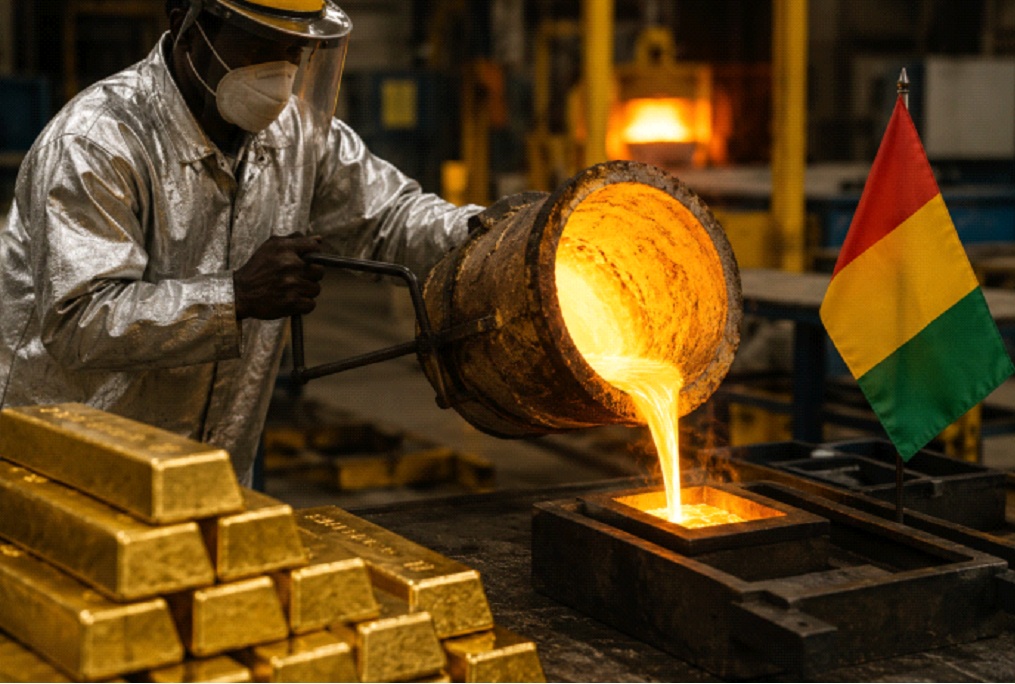
Guinea’s Export Ban and the Continental Fight for Mineral Value Creation
Guinea’s prohibition on the export of raw gold — requiring all gold produced in the country to be refined and certified locally at the Nimba Gold Refinery before entering international markets — is among the most direct assertions of mineral sovereignty that any African government has made in the current era of intensifying competition over strategic resources. President Mamadi Doumbouya’s announcement converts a development principle that has been articulated across the continent for decades into operational policy: that the economic benefits associated with refining, certification, and downstream processing of Guinea’s mineral wealth should accrue to Guinea rather than to the external centres that have historically captured those margins by processing African raw materials elsewhere. The reform addresses not only the immediate economics of the gold trade but the structural pattern it embeds: a logic in which Africa extracts and the world refines, a division of labour that systematically transfers value from producing countries to processing countries regardless of where the geological endowment actually lies.
The policy reflects a broader transformation in African resource governance that is gathering momentum across the continent, where governments are increasingly seeking to move beyond extractive economic models centred on raw commodity exports. Similar initiatives — mandatory local processing requirements, state ownership floors in mining ventures, export restrictions tied to domestic beneficiation plans — have emerged in countries ranging from Zimbabwe to Tanzania, Mozambique, and now Guinea, reflecting a growing consensus that natural resource extraction without domestic value addition is not development but its deferral. By encouraging local beneficiation, Guinea aims to stimulate industrial development, expand skilled employment, improve fiscal revenues, and build the institutional and technical capacity that allows a country to participate in the higher-margin stages of mineral value chains rather than remaining permanently at the extractive end where returns are most exposed to commodity price volatility.
The success of the reform will ultimately depend on Guinea’s capacity to expand refining infrastructure at a pace sufficient to absorb production, maintain regulatory consistency that sustains investor confidence in domestic processing commitments, and build the transparent governance frameworks that allow the policy to deliver its stated benefits to Guinean communities rather than being captured by the institutional arrangements that have historically sat between resource revenues and public welfare in extractive economies. If effectively implemented, domestic refining could transform Guinea’s relationship with global gold markets from price-taker to value-creator — a transition that carries implications extending far beyond the gold sector into the broader question of what resource sovereignty actually means when it is measured not by formal ownership of mines but by the percentage of the value chain that stays within the country that produced the ore. Guinea’s ban is therefore not the end of that question — it is an unusually direct attempt to begin answering it.





