
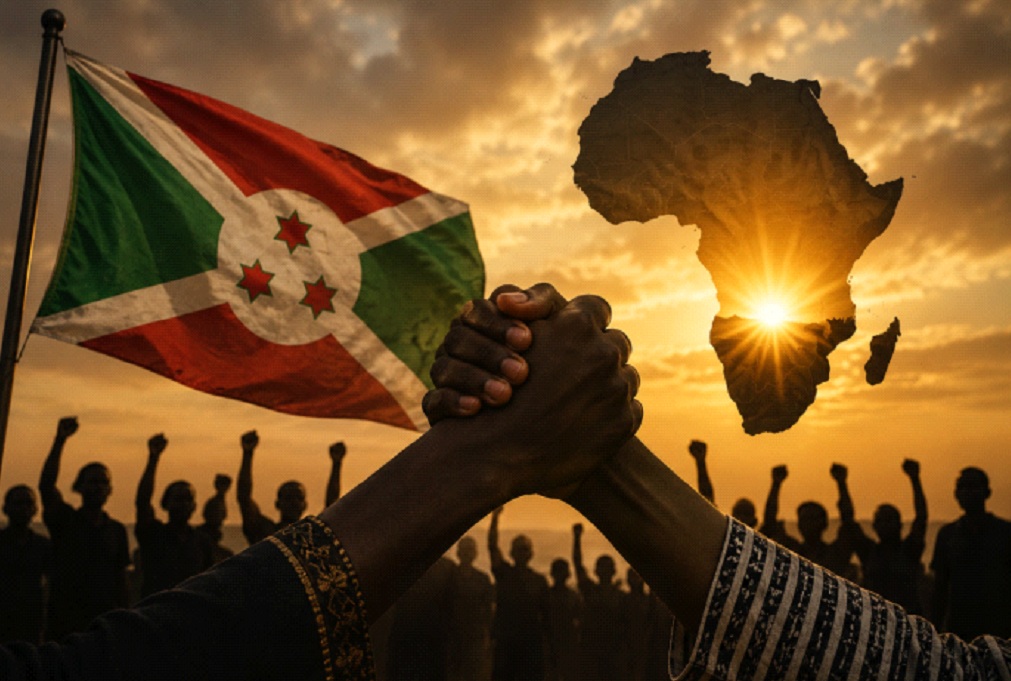
Africa Must Govern Itself: Ndayishimiye’s Pan-African Challenge to the Global Order
Presidence de la République du Burundi – Burundian President Évariste Ndayishimiye used Africa Day commemorations to deliver a pointed political message about the continent’s future: Africa must become more united, more sovereign, and less dependent on the external power centres that continue shaping its economic and security realities. Speaking as Chairperson of the African Union, Ndayishimiye’s appeal for “a united, sovereign Africa turned toward the future” went beyond ceremonial Pan-African rhetoric. It emerged at a moment when African governments are increasingly confronting the limits of a global order in which the continent remains strategically important for its minerals, markets, labour, and geopolitical position — yet consistently marginalised in the international decision-making structures that govern those very assets.
The speech arrives amid growing continental debates around economic dependency, security partnerships, and institutional autonomy. Across the Sahel and other parts of Africa, governments and political movements have increasingly challenged foreign military influence, unequal trade systems, and development models perceived to reinforce long-term dependency rather than sovereign transformation. Ndayishimiye’s emphasis on African-led cooperation and stronger continental solidarity aligns with a wider political current seeking greater control over regional governance, strategic resources, and diplomatic direction. At the same time, the call for unity reflects awareness that fragmentation among African states continues to weaken the continent’s collective bargaining power in an era of intensifying global competition over energy, minerals, trade routes, and geopolitical alliances.
For Burundi, the intervention also signals an effort to reposition itself within continental political leadership after years of international isolation and domestic turbulence. Since assuming the AU chairmanship, Ndayishimiye has increasingly framed Burundi as part of a broader African push for institutional reform, strategic autonomy, and renewed Pan-African cooperation. Yet the deeper significance of his remarks lies in what they reveal about the continent itself: a growing recognition that political independence without economic leverage and regional coordination leaves African sovereignty structurally incomplete. As global powers compete more aggressively for influence across Africa, calls for continental unity are no longer being framed as historical ideals — they are being articulated as the only strategic response capable of securing African political and economic futures in a rapidly shifting world.





