
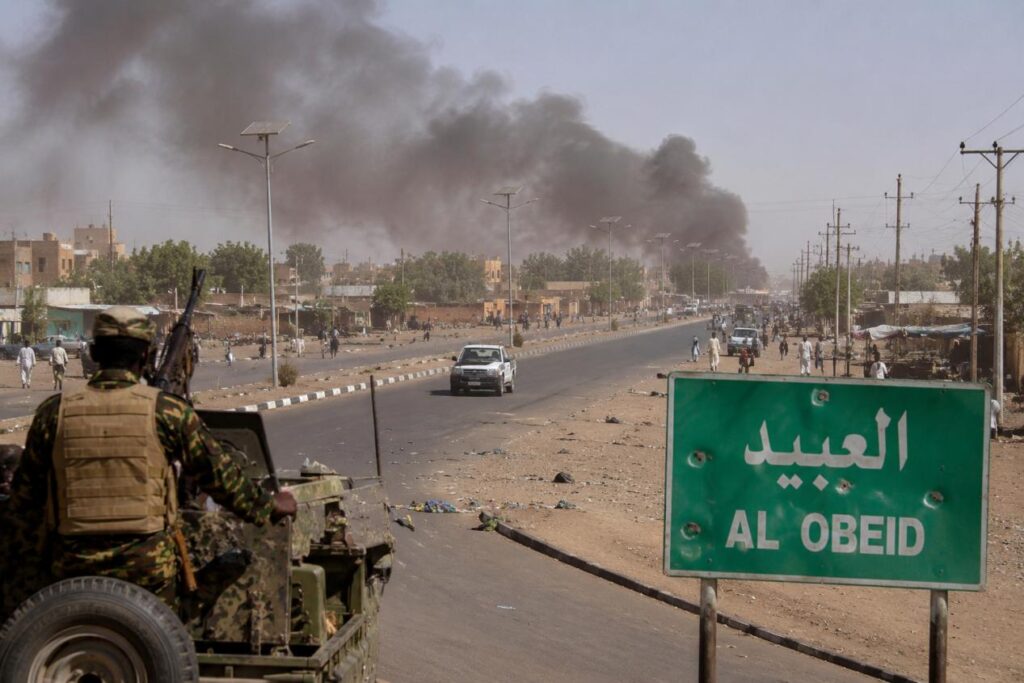
Al-Obeid Is Not Just a City — It Is the Shape of Sudan’s Future: Control of the Heartland Will Determine What Comes After the War
The United Nations’ warning that a human rights catastrophe is unfolding in Al-Obeid — where fighting between the Sudanese Armed Forces and the Rapid Support Forces has intensified around a city whose commercial and transportation significance makes it one of the most strategically contested sites of Sudan’s civil war — is a humanitarian alert whose political meaning is inseparable from its geography. Al-Obeid’s position as a vital hub linking central Sudan with western regions means that whoever controls it gains leverage not only over military positioning but over trade routes, supply networks, and the political economy of the country’s interior. Civilians experiencing worsening water shortages, growing insecurity, and repeated displacement are therefore caught not only in a military confrontation but in a contest whose resolution will shape the territorial and economic architecture of whatever state emerges from Sudan’s current fragmentation.
The humanitarian crisis in Al-Obeid illustrates how Sudan’s civil war has evolved into something qualitatively different from a bilateral military contest: a competition over the productive and logistical geography of a vast country in which armed groups, governance networks, informal economies, and civilian survival strategies have become entangled in ways that make humanitarian response both urgently necessary and structurally inadequate. In areas where state authority has contracted, economic activity organises itself around the security arrangements that armed actors provide — creating dependencies that make neutrality impossible and survival dependent on navigating competing spheres of armed control. The governance vacuum that fighting creates is not merely an absence of services but a restructuring of political authority whose consequences will outlast any ceasefire.
The battle for Al-Obeid therefore represents more than a military flashpoint in a larger war; it is a test of whether Sudan’s territorial cohesion can survive a conflict that has systematically weakened the central institutions through which national governance was organised. The longer key strategic centres remain contested, the deeper the entrenchment of the fragmented authority structures whose consolidation would make national reconstruction exponentially more difficult. Sudan’s international partners, regional neighbours, and the UN institutions documenting the humanitarian consequences are all confronting the same underlying reality: that the crisis in Al-Obeid is not a problem that humanitarian assistance resolves but a political and military dynamic that only a genuine political settlement can transform — and that every day without such a settlement is a day in which the conditions for one become harder to restore.





