
Beyond Borders: How Five Nations Are Building Africa’s Boldest Conservation Experiment
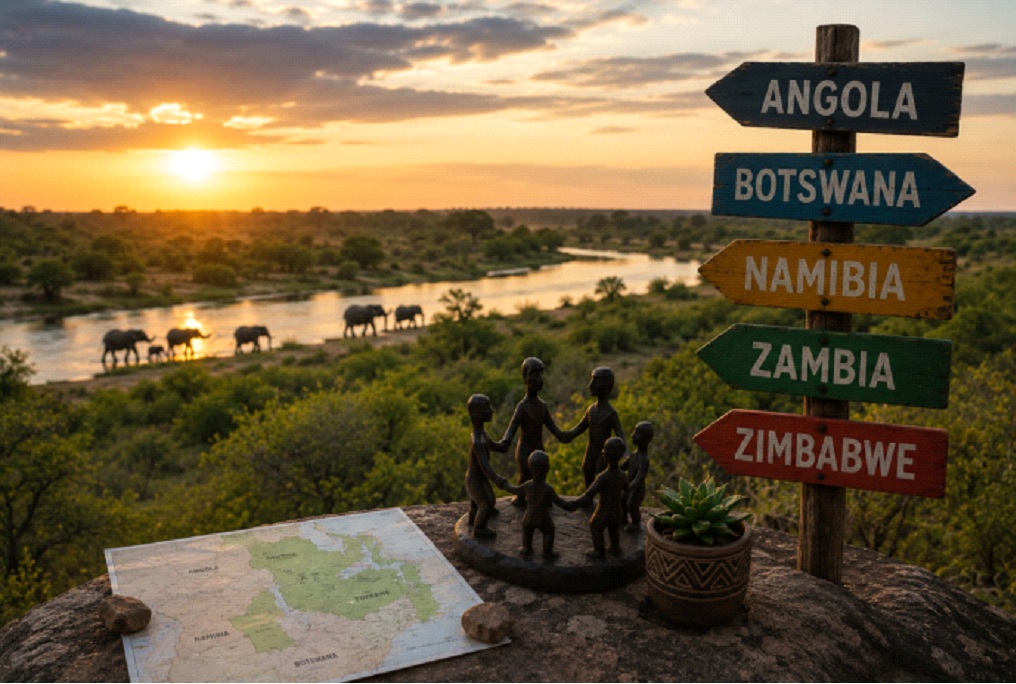
Across Southern Africa, elephants, rivers, forests, and migration routes continue moving through landscapes long older than the borders separating modern states. The announcement that the Kavango-Zambezi Transfrontier Conservation Area (KAZA TFCA) secured €6 million for its next operational phase therefore carried significance beyond conservation funding alone. Spanning Angola, Botswana, Namibia, Zambia, and Zimbabwe, KAZA represents one of Africa’s most ambitious regional projects — an effort to manage wildlife, tourism, ecosystems, and rural development cooperatively across national boundaries that colonial partition once hardened into separate administrative spaces. The new funding will strengthen regional coordination, support conservation-linked livelihoods, and address growing tensions between wildlife protection and community survival.
What makes KAZA distinctive is that it treats regional integration not as an abstract diplomatic slogan, but as something rooted in shared geography and interconnected livelihoods. In many communities across the corridor, local economies depend simultaneously on farming, cross-border trade, tourism, and conservation-related employment — creating a social reality that rarely fits neatly within state boundaries. Yet the project also exposes difficult contradictions. Rural communities living alongside expanding wildlife populations increasingly confront crop destruction, restricted land access, and dangerous encounters with elephants and predators, while governments attempt to balance conservation goals with economic pressures and local frustration. The challenge facing KAZA is not simply environmental management, but whether regional cooperation can produce material benefits visible enough for ordinary communities to view conservation as part of development rather than exclusion.
The significance of KAZA ultimately lies in how it re-imagines sovereignty itself. Much of postcolonial African politics inherited borders designed primarily for extraction, territorial control, and administrative separation. KAZA operates from a different logic: that certain African realities — ecological systems, climate pressures, migration routes, and rural economies — are fundamentally regional and may require collective stewardship rather than isolated national management. The project still relies heavily on international financing and external partnerships, but politically it reflects a broader continental question increasingly shaping Africa’s future: whether neighbouring African states can build stronger forms of cooperation around shared resources and long-term sustainability without surrendering local interests or community dignity in the process. In a century defined by climate instability and intensifying competition over land and natural wealth, this Southern African conservation corridor is becoming as much a political experiment in regional coexistence as an environmental one.





