
Brazzaville as Beacon: Congo’s Role as Africa’s First DDHU Base Connects Human Rights to Environmental Sovereignty
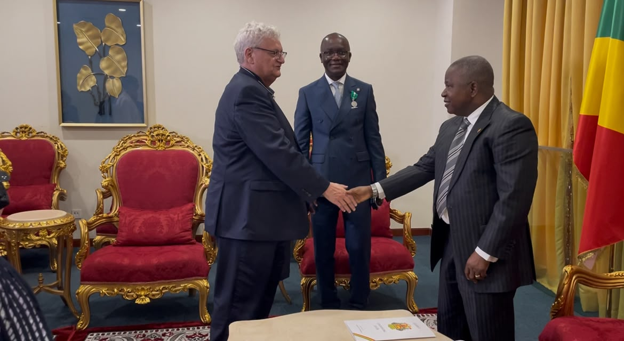
The establishment of the Universal Declaration of Human Rights organisation’s first African national branch in Brazzaville — inaugurated under the leadership of Brice Voltaire Etou Obami and formalised through a meeting with Senate President Pierre Ngolo attended by DDHU Secretary-General Christophe Giovaneti, former France-Africa Summit Secretary-General Stéphanie Rivoal, and UNESCO Ambassador for Peace Clara Kessous — is a human rights governance development whose choice of location is as significant as its institutional content. The Republic of Congo’s selection as the DDHU’s African continental gateway reflects a deliberate recognition of the country’s role within the Congo Basin ecosystem, whose status as one of the world’s most critical carbon sinks and biodiversity reserves gives environmental rights advocacy conducted from Brazzaville a geographic credibility and strategic significance that few other African capitals can match.
The DDHU’s thematic focus — incorporating environmental protection and the rights of future generations alongside the justice, equality, women’s rights, children’s welfare, and social inclusion dimensions of conventional human rights advocacy — reflects a conceptual evolution in how rights frameworks are being adapted to address the interconnected challenges of the 21st century. The connection between environmental rights and human rights is not merely philosophical: communities whose water sources are contaminated, whose agricultural land is degraded, whose forest resources are depleted by extraction that benefits distant actors, or whose climate vulnerability is produced by emissions generated elsewhere are experiencing human rights violations whose recognition within formal rights frameworks creates new accountability mechanisms for the governance of natural systems. Congo’s Congo Basin position makes it an ideal platform from which to develop and advance this integrated advocacy.
The planned training workshops on equality, protection of life, and survivor support — alongside the DDHU’s expressed intent to develop educational, agricultural, and social welfare initiatives through partnerships with government and civil society — reflect an operational philosophy that treats human rights not as a monitoring and documentation function alone but as a development programme whose practical outputs include improved community welfare, stronger local institutions, and expanded access to justice for the populations whose rights the organisation is committed to protecting. The Republic of Congo’s willingness to host this continental initiative reflects a governing openness to rights-based development frameworks whose presence in Brazzaville, at the centre of one of Africa’s most environmentally and developmentally significant ecosystems, could generate advocacy whose continental reach extends well beyond the country’s own borders.





