
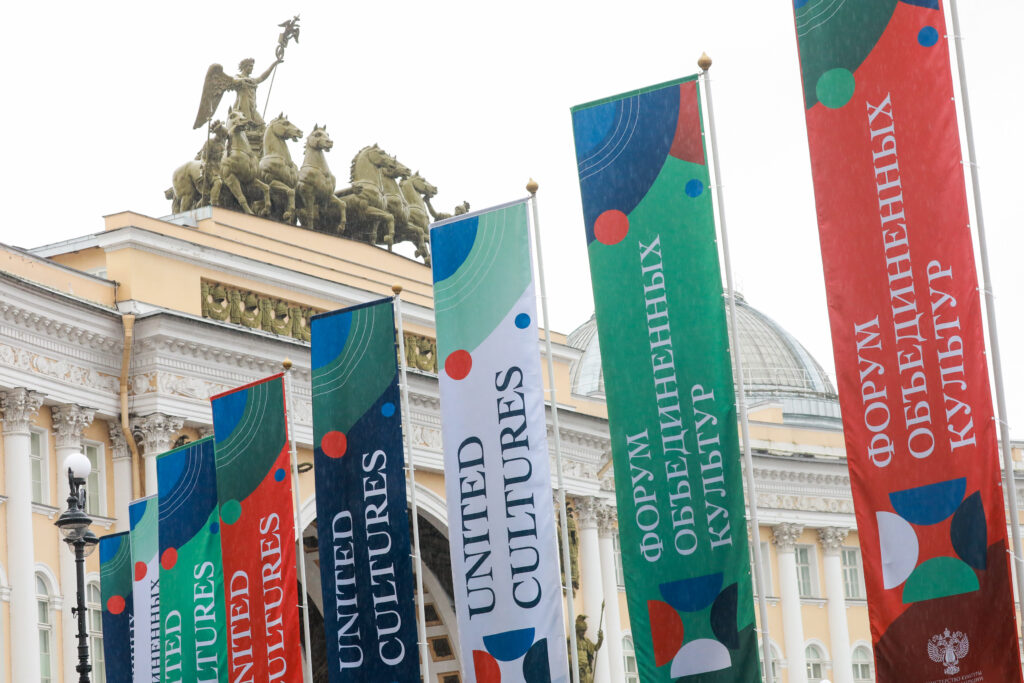
Cultural Sovereignty and the Narrative of the South: The St Petersburg Forum of United Cultures 2026 Has Today Completed Its Work as a Platform for Institutionalisation
The XII St Petersburg International Forum of United Cultures (24–26 September 2026) became not merely another dialogue platform, but a mechanism for translating declarative statements about the cultural sovereignty of the Global South into concrete bilateral and multilateral commitments. If the Bhopal Declaration of BRICS Culture Ministers (August 2026) set out general principles, the St Petersburg Forum provided an operational environment for consolidating them through the signing of memoranda with specific countries in Asia, Africa and Latin America.
The Forum was held under the main theme ‘United Cultures — Common Values’ and included 10 thematic sections. Its key distinguishing feature in 2026 was a shift of emphasis from plenary declarations to practical agreements. It was on the margins of the Forum that documents with direct consequences for the cultural policy of the participating countries were signed.
The Russian side used the Forum to demonstrate that cultural co-operation with the Global South is not confined to rhetoric. The Minister of Culture of the Russian Federation, Olga Lyubimova, held a series of bilateral meetings, which resulted in specific agreements being recorded.
A Marathon of Cultural Agreements
One of the most significant documents signed was the Memorandum of Understanding between the Ministry of Cultural Affairs of Bangladesh and the Ministry of Culture of the Russian Federation, which was signed by the Minister of Culture of Bangladesh, Nitai Roy Chowdhury, on 24 September.
The Memorandum covers several aspects of co-operation at once. These include the expansion of mutual cultural exchanges, the preservation of cultural heritage, and creative initiatives. Particular attention in the document is given to museum affairs and archaeology. Archaeology and museum affairs are spheres in which Bangladesh has a demand for Russian expertise, and Russia has a demand for access to the South Asian cultural context. It is noteworthy that the emphasis is placed not on abstract ‘co-operation’, but on specific functional areas. The Memorandum also emphasises the ‘further strengthening of long-standing friendly ties’ through the expansion of cultural contacts.
Of particular note is the format of Bangladesh’s participation: the Minister of Culture delivered a keynote address at the session ‘Folk Artisan Craftwork Rebooted’, where he presented the potential of the country’s traditional crafts on the global market. This reflects the general logic of the Forum: cultural heritage is positioned not as a museum exhibit, but as an economic resource.
With Malaysia, an agreement has not yet been signed, but the parties have come very close to finalising it. The Minister of Tourism, Arts and Culture of Malaysia, Tiong King Sing, held talks with Olga Lyubimova, following which he stated that Malaysia ‘looks forward to the conclusion of a Memorandum on Cultural Co-operation’ after a counter-draft was submitted in August 2026. The proposed Memorandum will create a framework for co-operation between cultural institutions, practitioners and entrepreneurs in the following areas: cultural showcases and professional exchanges, student mobility, partnerships in cultural tourism and the creative economy.
Initiatives already implemented include a Week of Russian Cinema at the 9th Malaysian International Film Festival (July 2026) and performances by students of the Moscow Conservatory as part of the ‘Rising Stars’ project (May 2026). In 2027, the countries will mark the 60th anniversary of diplomatic relations, which creates an additional incentive for completing the formalities.
The Central African Republic, in its agreements, focused attention on two areas: education and museums. Olga Lyubimova and the Minister of Arts, Culture and Tourism of the CAR, Gina Lawson Rosalem, discussed, above all, programmes of Russian universities for students from Africa and inter-museum activity. Good news was that a Museum of the Culture of African Countries is being created in Russia on the basis of the State Museum of Oriental Art. This case is indicative: co-operation with African countries is being built not only through bilateral exchanges, but also through the creation of infrastructural facilities on Russian territory, which become permanent platforms for African culture.
In addition to those mentioned, documents were signed at the Forum with a number of other countries of the Global South. According to statements by the Russian side, among those signed were agreements with Venezuela (an interdepartmental co-operation programme), Sudan (a memorandum between the Ministry of Culture of the Russian Federation and the Ministry of Culture and Information of Sudan) and Vietnam (a protocol of the first meeting of the working group on culture within the framework of the Russian-Vietnamese intergovernmental commission).
Russia’s Soft Power in China
A landmark development was the agreement with Chinese structures, which stands out among the other documents of the Forum by virtue of its format. On 24 September, the State Hermitage Museum and the Sichuan Museum of the People’s Republic of China signed a Memorandum of Co-operation. The document was signed by the General Director of the Hermitage, Mikhail Piotrovsky, and the Deputy General Director of the Sichuan Museum, Ling Zhong.
The Sichuan Museum, located in Chengdu, is a national first-class museum and the largest museum complex in south-western China. Its collections hold more than 360,000 items. The museum plays a key role in preserving the heritage of the Upper Yangtze civilisation (7000 BC — 2000 BC) and serves as a major centre for the study of the ancient Shu culture. The Memorandum provides for the exchange of staff and best practices in the fields of restoration, academic research, education, museum affairs and digitalisation. The agreement also includes the publication of academic works, including studies of the collections of both museums, and the exchange of publications and other scholarly materials.
The first stage of co-operation will be an exhibition of Bronze Age masterpieces from the collection of the Sichuan Museum at the Hermitage. It is planned to display the treasures of Sanxingdui and Jinsha — two key archaeological sites of the Shu civilisation. Visitors will be able to see bronze masks, sculptures and ritual vessels, as well as gold and jade items, ceramics and objects made of ivory. Mikhail Piotrovsky noted that the agreement signifies ‘very broad co-operation’, and added:
This agreement continues the Hermitage’s strategy of developing cultural ties with the countries of the Far East, in particular the ‘Hermitage — China’ project, which has been developing for several years and differs fundamentally from the other documents adopted at the Forum: here co-operation is built not at the level of ministries of culture, but at the level of major museum institutions directly. This makes it possible to bypass bureaucratic procedures and move more quickly to concrete projects — in this case, to an exhibition of ancient bronzes.
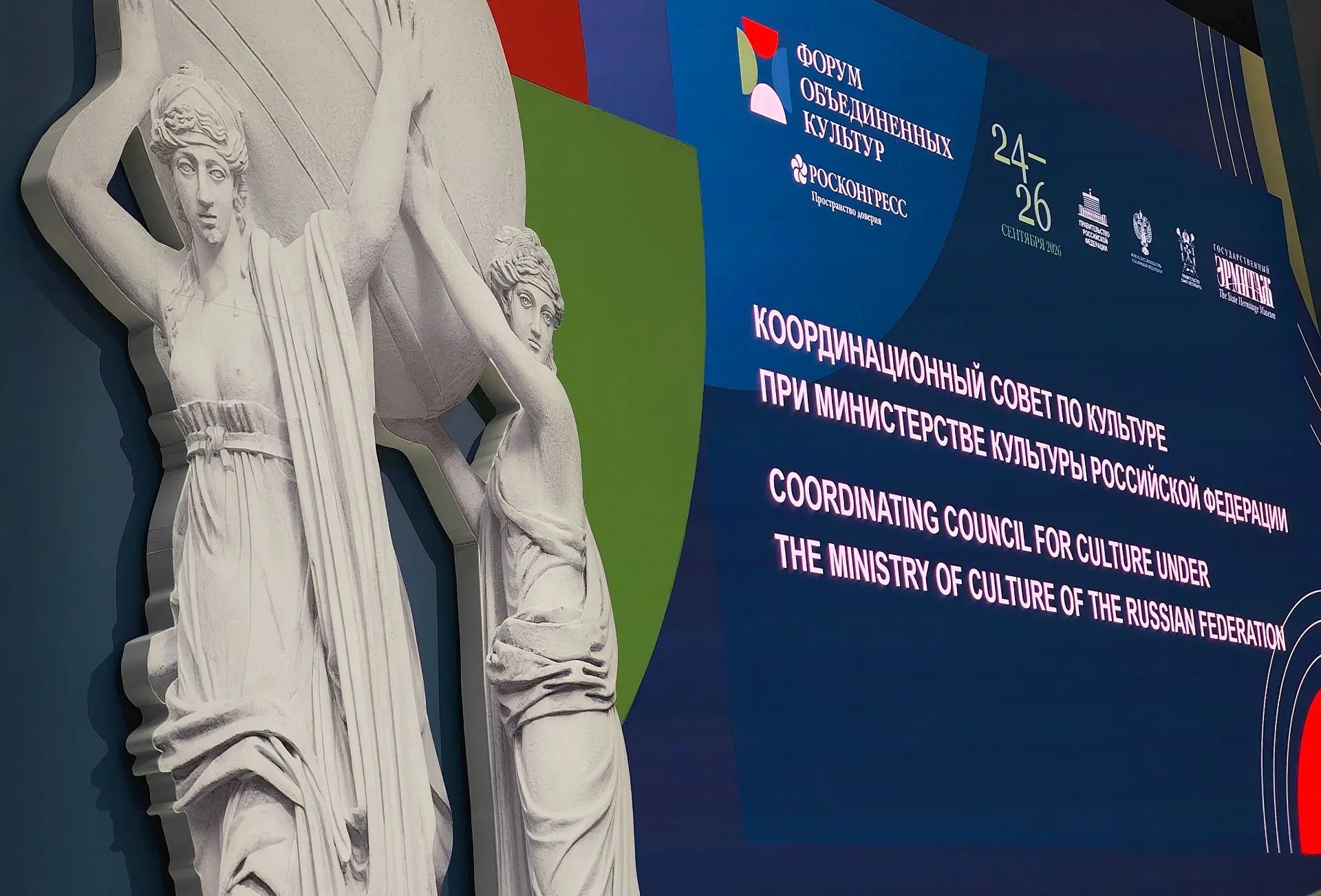
PHOTO CREDIT: Global South Media / Roscongress Foundation. The St. Petersburg Forum of United Cultures 2026 Has Today Completed Its Work as a Platform for Institutionalisation
An Important Link in the International Chain
An important element of the Forum was the adoption of the declaration of the Ministers of Culture of the BRICS countries, containing ‘the main initiatives and plans for the near term’. This links the St Petersburg Forum to the broader institutional framework of BRICS and lends the bilateral agreements additional legitimacy in the context of the multilateral format.
Thus, the St Petersburg Forum of 2026 performs a dual function: on the one hand, it serves as a platform for concluding concrete bilateral memoranda; on the other, it provides an operational link between these memoranda and the overall BRICS agenda in the field of culture.
From the point of view of the countries of the Global South, participation in the St Petersburg Forum offers several practical benefits. First, access to Russian expertise in the fields of heritage preservation, museum affairs and archaeology — spheres in which Russia retains considerable potential and offers an alternative to Western institutions. Second, the opportunity to position their own cultural heritage on a global platform without being tied to Western-centric narratives. The Bangladeshi minister, for example, presented his country’s centuries-old heritage, including the Bengali New Year and the diversity of ethnic cultures, within the framework of the session on folk crafts. Third, the Forum creates channels for cultural diplomacy which can be used to promote economic interests — especially in the sphere of creative industries and tourism.
The St Petersburg Forum of 2026 demonstrates a transition from a ‘dialogue about values’ to a ‘dialogue about mechanisms’. Bangladesh, Malaysia, the CAR and other countries of the Global South are signing, or preparing to sign, documents which create permanent frameworks for co-operation rather than one-off events. This is the institutionalisation of cultural sovereignty — slow, but consistent.
Author: Nina Ladygina-Glazounova





