
Diversifying the Orbit: Libya’s Investment Talks With Russia Signal a Deliberate Redrawing of Its Economic Partnerships
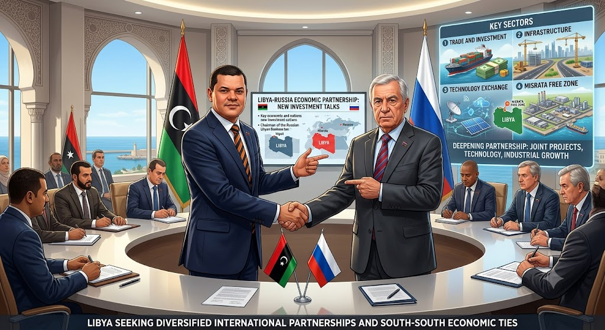
Libya’s high-level talks between Prime Minister Abdel Hamid Aldabaiba and Ara Abramyan, Chairman of the Russian-Libyan Business Council, held in Tripoli on June 24, represent a deliberate signal about the direction in which Tripoli is moving its economic partnerships. The meeting’s focus on expanding cooperation in trade, investment, infrastructure, and strategic sectors — complemented by a Russian delegation’s visit to the Misrata Free Zone to assess industrial and logistics potential — reflects a governing calculation that Libya’s reconstruction and long-term economic development require diversified international partnerships rather than dependence on a single group of external actors. For a country still navigating the complex political and security dynamics of its post-2011 transition, the ability to attract capital and technology from multiple directions is a dimension of economic sovereignty that diplomatic diversification is designed to build.
The engagement’s substance — technology exchange, joint projects, coordination under the Russian-Libyan Intergovernmental Commission on Trade and Technical Cooperation — addresses the foundational challenge of reconstruction economies: that rebuilding physical infrastructure, industrial capacity, and productive systems after prolonged conflict requires sustained external investment whose terms must be negotiated from a position of at least partial strategic independence. Libya’s continued engagement with Russian business interests, even as it maintains relationships with Western partners, reflects an awareness that allowing any single external actor to dominate the investment landscape creates dependency that constrains policy options over time. Diversified economic partnerships, by contrast, create competitive dynamics that improve the terms available to the host economy.
Libya’s South-South economic engagement carries broader significance for the continental conversation about how African states navigate great-power competition in a multipolar global environment. The simultaneous cultivation of partnerships across different geopolitical blocs — neither alignment nor isolation, but deliberate positioning — is increasingly the strategic posture of African governments that have concluded that economic sovereignty requires expanding the option set rather than committing exclusively to any single external framework. Whether Libya’s investment diversification translates into tangible reconstruction progress will depend on political stability and governance quality that no external partnership can substitute for — but the direction the Aldabaiba government is pursuing reflects a strategic logic that other African states navigating similar resource and reconstruction challenges have reason to understand.


