
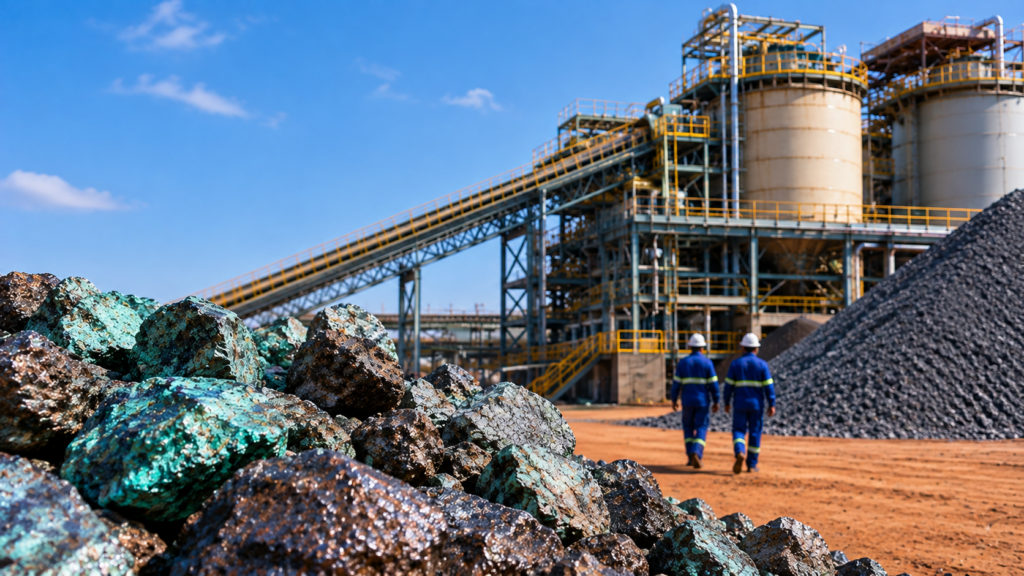
DRC Moves to Capture More Value from Its Copper and Cobalt Wealth
The Democratic Republic of the Congo is tightening controls on copper and cobalt concentrate exports as it seeks to push more mineral processing into the country and retain a greater share of the value generated from its resources. According to Mining Weekly, citing BMI, a ministerial order dated 29 June 2026 prohibits the export of copper and cobalt concentrates, while allowing one-year waivers under strategic circumstances and introducing a new tax regime for economically significant mining by-products. BMI interprets the measure as a shift from a longstanding de facto restriction to a formal de jure ban, with tighter conditions governing exemptions.
The immediate effect on global markets is expected to be limited because most of the DRC’s copper is already exported in refined form. BMI estimates that concentrates accounted for about 13% of the country’s copper exports in 2025, equivalent to roughly 400,000 tonnes of copper metal, while Reuters reported that the DRC exported substantially more refined copper than concentrate in the first quarter of 2026. Cobalt is even less directly exposed because the DRC primarily exports cobalt hydroxide, which is already subject to a separate quota system. At the same time, the country is expanding its ability to process copper domestically, including through the 500,000-tonne-per-year Kamoa-Kakula smelter, which Reuters reported was operating at about 60% of design capacity in February.
The policy is therefore significant less for its immediate effect on global supply than for what it says about the DRC’s approach to resource sovereignty and domestic value addition. The government is seeking to move further down the mineral value chain rather than remain primarily an exporter of raw or semi-processed resources, with the latest order explicitly aimed at encouraging mining operators to market products with higher added value. The strategy, however, will require sufficient smelting capacity, reliable energy, investment and commercially viable processing infrastructure to avoid simply shifting the bottleneck from exports to domestic production. For the DRC, the central challenge is turning control over mineral exports into lasting industrial capacity and a greater domestic share of the wealth generated by its copper and cobalt resources.





