
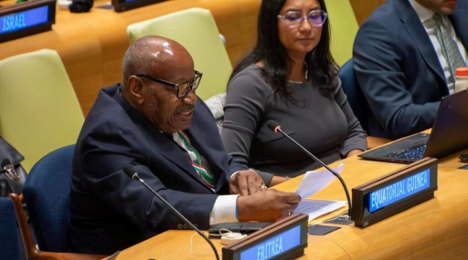
Equatorial Guinea Calls for Total Nuclear Disarmament and Stronger African Nuclear-Free Zone
Equatorial Guinea has called for the complete and irreversible elimination of nuclear weapons, placing African disarmament and the peaceful use of nuclear technology at the centre of its intervention at the United Nations. Speaking during the UN General Assembly’s high-level session commemorating the International Day for the Total Elimination of Nuclear Weapons, Equatorial Guinea’s Permanent Representative, Ambassador Anatolio Ndong Mba, reaffirmed the country’s opposition to nuclear arsenals and joined the declaration presented by Burundi on behalf of the African Group before delivering Equatorial Guinea’s national position. According to the Government of Equatorial Guinea, the ambassador argued that lasting international security cannot be built on nuclear deterrence and called for the irreversible eradication of existing arsenals. The UN’s own record of the session similarly records Equatorial Guinea’s position that international security should move toward the total elimination of nuclear weapons through a universal, verifiable and irreversible process.
A central element of the intervention was the Pelindaba Treaty, which establishes Africa as a nuclear-weapon-free zone. Equatorial Guinea urged nuclear-weapon states to ratify the treaty’s relevant protocols while stressing the importance of Africa maintaining its collective rejection of nuclear weapons. The African Union records that the Pelindaba Treaty was adopted in 1996 and entered into force in 2009, providing the legal framework for Africa’s nuclear-weapon-free zone. Equatorial Guinea also invoked Article VI of the Nuclear Non-Proliferation Treaty, calling on nuclear-armed states to fulfil their disarmament commitments in good faith. The country’s representative further argued that the resources devoted to maintaining and modernising nuclear arsenals could instead support education, healthcare, climate action and the implementation of the UN 2030 Agenda and the African Union’s Agenda 2063. Equatorial Guinean publication La Gaceta de Guinea Ecuatorial likewise reported that the country’s intervention called for stronger disarmament and non-proliferation mechanisms alongside the peaceful use of nuclear energy.
Equatorial Guinea’s position also reflects a broader argument that African security should be pursued through development, international law and multilateral cooperation rather than dependence on weapons of mass destruction. Ambassador Ndong Mba referred to Equatorial Guinea’s own experience with threats of destabilisation and argued that genuine security should instead be grounded in solidarity and sustainable development. The government further expressed support for the entry into force and universal application of the Treaty on the Prohibition of Nuclear Weapons, describing it as a universal, verifiable and non-discriminatory framework, while insisting that nuclear energy should be used exclusively for peaceful purposes. The position is consistent with Equatorial Guinea’s earlier interventions at the UN, where it has repeatedly supported nuclear disarmament and the peaceful uses of nuclear technology.





