
Global South Must Break Free from Western Media Domination — Kwesi Pratt Jnr.
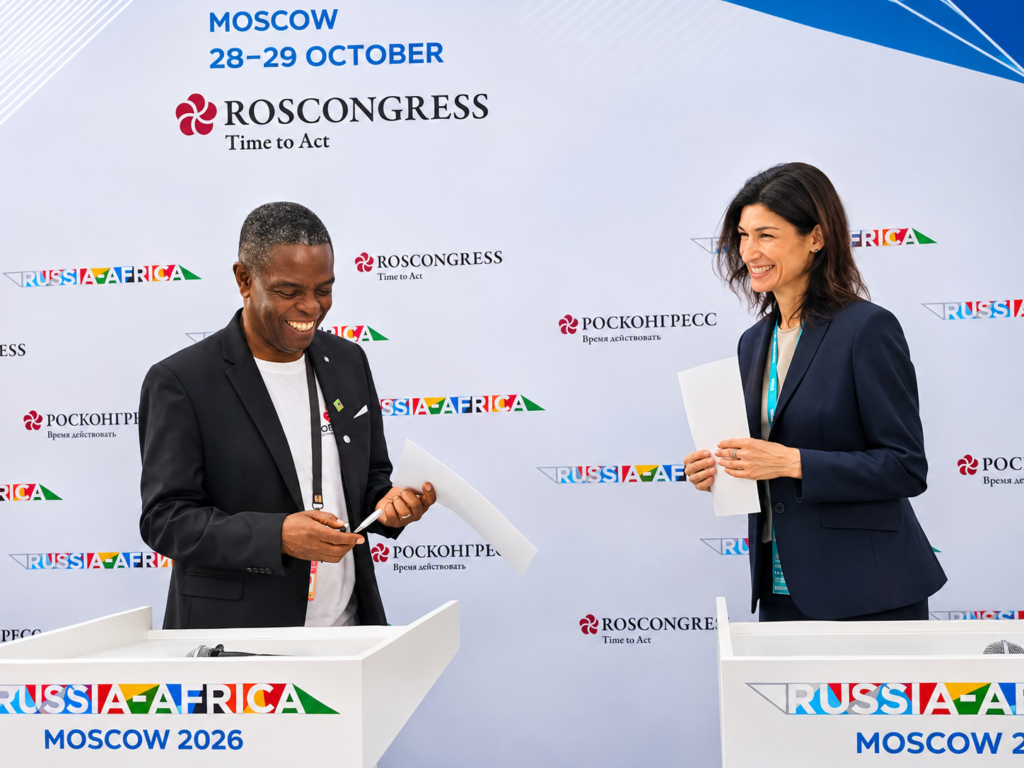
Mr. Pratt made the remarks in Moscow on 28 October 2026, following the signing of a Memorandum of Understanding between the Pan-African Television Network and Global South Media on the sidelines of the Russia–Africa Summit.
He argued that Western media narratives undermine efforts to mobilise people against economic domination and exploitation, insisting that the Global South must develop its own capacity to communicate its struggles and aspirations.
Building a Unified Global South Media Voice
Mr. Pratt maintained that media cooperation must go beyond exchanging content and become part of a broader effort to challenge unequal global power relations.
The agreement between the two media organisations, signed by Pratt and Global South Media Editor-in-Chief Ekaterina Emelianenko, provides a framework for cooperation towards this objective.
Commenting on the significance of the agreement, Ms. Emelianenko emphasised its importance for strengthening international media partnerships and developing closer cooperation between media organisations across the Global South.
“The signing of a cooperation agreement with the Pan-African Television Network marks an important step in the development of international media partnerships and the strengthening of ties between media organizations across the Global South,” she said. She stressed that countries of the Global South must move beyond simply being represented in international news coverage and take an active role in shaping the global information agenda.
The statements by both media leaders reflect a shared recognition that greater control over information production and distribution is essential for strengthening the Global South’s voice in international affairs.
Such cooperation raises a fundamental question about the global information order: whether societies whose economic and political interests are marginalised within existing international structures can achieve meaningful independence without greater control over the means through which their realities are communicated.
Beyond Content Exchange: Towards Strategic Media Cooperation
For both organisations, the agreement represents an opportunity to develop cooperation extending beyond the conventional exchange of news and editorial materials.
Emelianenko highlighted the potential to combine professional expertise, media resources and audiences to strengthen the international visibility of African perspectives.
The partnership could provide a foundation for joint editorial initiatives, direct information exchange and closer professional engagement between Russian and African journalists.
Such initiatives would help African media organisations communicate their own political, economic and social realities to international audiences while reducing their reliance on external intermediaries.
Digital Sovereignty and the Challenge of Western Platforms
Mr. Pratt also warned that dependence on Western-owned digital platforms extends the problem of media domination into the digital sphere, where corporations exercise considerable control over information distribution, user data and visibility through algorithms.
arguing that the collection and use of data by these companies pose serious concerns for the sovereignty of countries in the Global South.
He further criticised the censorship and algorithmic control exercised by these platforms, stressing that “it is absolutely essential for us to begin to create our own platform.”
His remarks underscore the need for the Global South to move beyond dependence on communication infrastructures controlled by powerful foreign corporations and build independent systems capable of serving its own people and interests.
A Shared Vision for the Future of Global South Media
The positions expressed by Mr. Pratt and Ms. Emelianenko demonstrate that the cooperation between the Pan-African Television Network and Global South Media is rooted in a broader ambition to strengthen the ability of African countries and other nations of the Global South to communicate their perspectives independently.
While Mr. Pratt emphasised the structural inequalities of the existing international information system and the need to challenge Western media dominance, Ms. Emelianenko focused on the practical mechanisms required to establish sustainable partnerships, expand international audiences and develop joint media projects.
Together, these approaches highlight the importance of combining a shared strategic vision with concrete institutional cooperation.
Concluding her remarks, Ms. Emelianenko outlined the central objective of the partnership:
“Our shared mission is to ensure that the voice of Africa and the entire Global South is heard around the world — independently, confidently, and on an equal footing.”
The memorandum between the two organisations therefore represents more than a bilateral media agreement. It reflects a growing effort to establish direct communication channels, strengthen professional solidarity and create a more diverse international information environment in which the Global South can participate not merely as a subject of global news coverage, but as an independent contributor to the narratives shaping international discourse.
Author: Amanda Lucas





