
Green Finance as Competitive Strategy: How Côte d’Ivoire Is Turning Climate Resilience Into an Economic Advantage
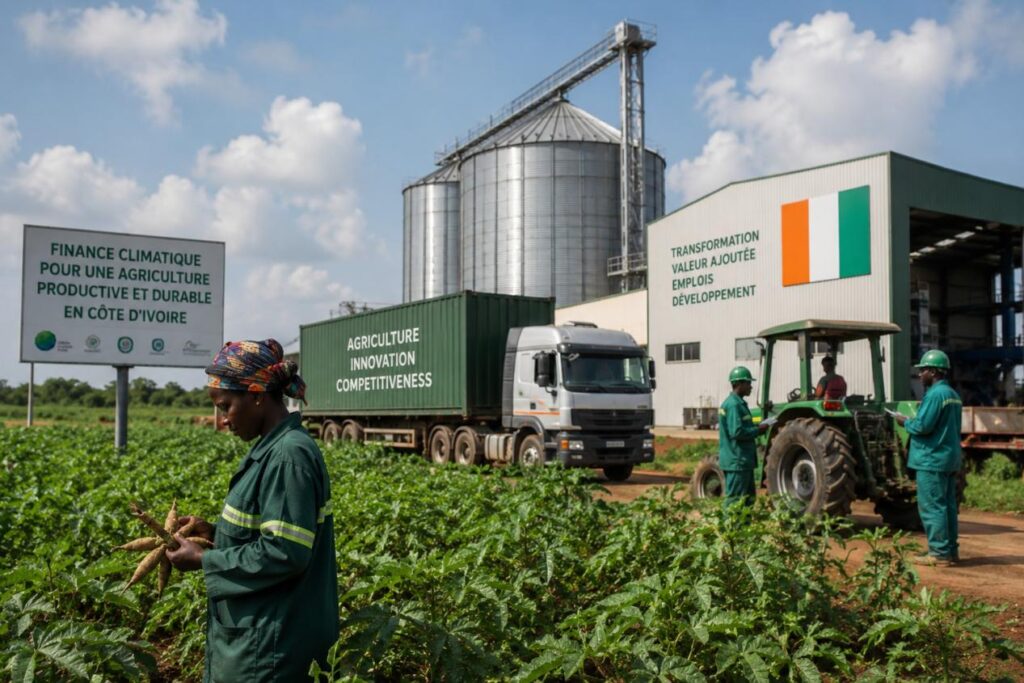
The approval of US$50 million in Green Climate Fund financing for Côte d’Ivoire’s agricultural sector — supporting the LARACI project’s investment in climate-resilient production systems for rice, cassava, and yam, alongside land management improvements and agricultural advisory services — reflects a governing philosophy whose significance lies in how it frames climate finance rather than simply in its quantum. Côte d’Ivoire’s approach positions climate resilience not as a concession to environmental advocacy but as a dimension of economic competitiveness: an investment in the productive foundations that sustained agricultural growth requires as climate pressures increasingly shape output variability, soil quality, water availability, and the reliability of the seasonal conditions on which smallholder farming systems depend. This reframing matters because it determines whether climate finance mobilises genuine productive investment or remains in the silo of environmental compliance spending whose development impact is secondary.
The specific economic stakes of climate inaction for Côte d’Ivoire make the LARACI investment’s logic straightforward. Irregular rainfall patterns, declining soil quality, and increasing weather variability are not abstract risks but documented threats to the agricultural productivity, rural incomes, and domestic food market stability on which the country’s economic and social performance depends. For an economy where agriculture remains a major source of employment and livelihood, the failure to invest in climate-smart productive systems does not avoid costs — it defers them to a future in which the adaptive challenge is larger and the fiscal resources available to address it are reduced by the economic losses that unmitigated climate stress has accumulated. The Green Climate Fund investment therefore represents not a trade-off between environment and economy but an integration whose logic is simultaneously developmental and strategic.
Côte d’Ivoire’s expanding engagement with the Green Climate Fund — alongside its broader climate investment pipeline and its partnerships with the African Development Bank and other international climate finance institutions — positions the country at the forefront of an African approach to climate policy that is increasingly consequential for how the continent engages global development finance. Countries that successfully integrate climate resilience into productive sector investment create a track record that attracts additional financing, builds institutional capacity for climate finance management, and demonstrates to international partners that development and environmental objectives can be advanced simultaneously. The success of LARACI will ultimately be measured in improved smallholder productivity, stronger food systems, and enhanced agricultural resilience — but its significance for Côte d’Ivoire’s longer-term development trajectory may lie in the institutional and financial relationships it builds along the way.





