
Journalism in the Age of Artificial Intelligence: Russia and Africa Build a New Framework for Media Cooperation
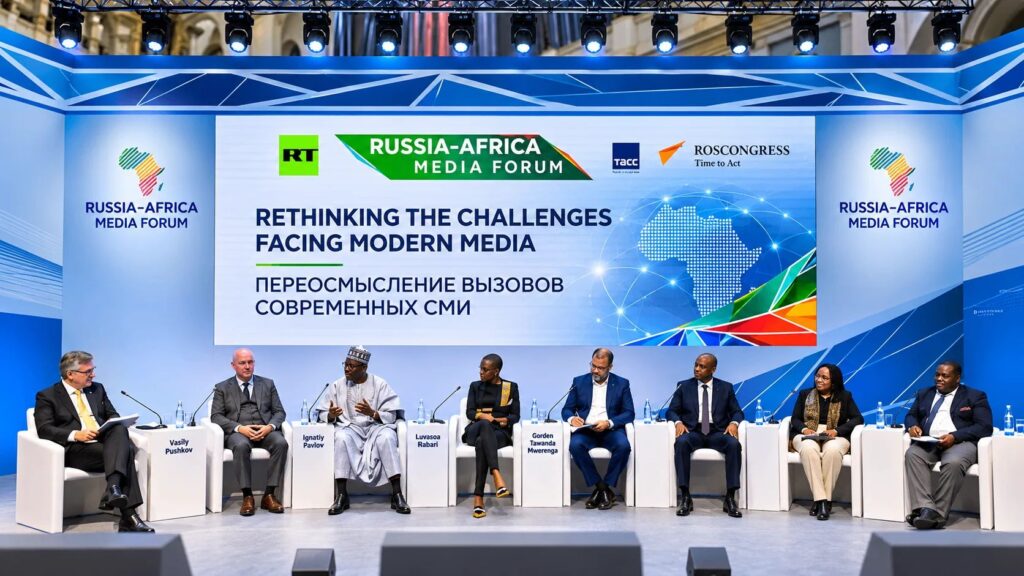
Artificial intelligence, the rapid expansion of social media, and the spread of misinformation are transforming the global media landscape. How can journalism maintain audience trust and adapt to new technological realities? These questions were at the center of a roundtable discussion titled “Rethinking the Challenges Facing Modern Media,” held in Moscow on October 29. The meeting brought together representatives of Russian and African media outlets as part of the Russia–Africa Media Forum, held on the sidelines of the Economic and Humanitarian Forum.
The discussion was moderated by Vasily Pushkov, Director for International Cooperation at the Rossiya Segodnya media group. Participants included executives from African and Russian media organizations, representatives of the media industry, and government officials.
Artificial Intelligence: A Threat or a Source of New Opportunities?
Kamel Mansari, Editor-in-Chief of the Algerian online publication Le Jeune Indépendant, offered an optimistic perspective on technological change. In his view, artificial intelligence may eliminate certain professions while simultaneously creating new ones. Referring to statistical research, he noted that a significant proportion of the public continues to distrust AI-generated content.
Luvasoa Rabari, Editor-in-Chief of the Madagascan online news portal 2424.mg, shared this perspective, emphasizing that journalism continues to fulfill an essential social function regardless of technological transformations.
A more critical assessment was presented by Gorden Tawanda Mwerenga, Chief Technology Officer at Zimbabwe Newspapers. He highlighted the profound transformation of media consumption following the widespread adoption of smartphones and the changing roles of traditional television, radio, and social media platforms. Nevertheless, he expressed confidence that journalism would endure as long as it remained grounded in accurate reporting and public trust.
Young Audiences Are Shaping the Future of Media
The discussion concluded with remarks by Ignatiy Pavlov, General Director of the Russian business newspaper Vedomosti. He emphasized the need for media organizations to reconsider their communication strategies and develop new approaches to engaging younger audiences.
According to Pavlov, a one-minute video does not have to mark the end of communication; instead, it can serve as the beginning of a meaningful dialogue. The experience of Vedomosti, which has successfully attracted younger generations not only as readers but also as employees, demonstrates how established media organizations can adapt to the digital environment.
From Historical Ties to Practical Media Partnerships
Russia–Africa media cooperation has deep historical roots. During the Soviet era, journalists from African countries received professional training in the USSR, while information exchanges developed alongside strengthening diplomatic and cultural relations.
Today, this cooperation is entering a new technological phase. In October 2024, the SputnikPro educational program organized training sessions for journalists from the Republic of the Congo, focusing on the use of artificial intelligence and podcast production. In April 2025, a Russia–Africa media forum was held in Addis Ababa, bringing together media professionals from several African countries.
The growing scale of cooperation was further demonstrated at the Moscow media forum in late October 2026. During the event, the international television network RT signed cooperation agreements with 12 African media organizations and government institutions. These agreements reflect the development of Russia–Africa media relations at a new institutional level, creating opportunities for sustainable professional partnerships, content exchange, and the expansion of joint media projects.
Another significant step was taken on October 28, 2026, in Moscow, when a memorandum of cooperation was signed on the sidelines of the Russia–Africa Economic and Humanitarian Forum between the Media Global South news agency (GlobalSouth.Media) and the Pan-African Television Network.
The memorandum was signed by Ekaterina Emelianenko, Editor-in-Chief of Media Global South, and Kwesi Pratt Jr., founder of the Pan-African Television Network. The memorandum aims to strengthen direct information exchange, develop professional ties, and expand opportunities for African perspectives to be represented in the international media landscape.
Why This Cooperation Matters Strategically
For African media organizations, direct partnerships with Russian news outlets offer opportunities to strengthen editorial and informational independence, reach wider international audiences, and promote African perspectives on global developments.
For Russia, such cooperation contributes to a deeper understanding of social and political processes across the African continent, the development of professional networks, and the expansion of its international media presence.
Of particular importance is the transition from simply exchanging published materials to jointly producing content, training journalists, and establishing sustainable information-sharing channels that do not depend exclusively on Western news agencies as intermediaries.
The central conclusion of the discussion was that the future of journalism will be shaped not only by technological innovation but, above all, by the ability of media organizations to maintain public trust and preserve their own independent professional voices.
Supported by educational initiatives and formal agreements between media organizations, Russia–Africa media cooperation is laying the groundwork for a more independent, diverse, and inclusive global information landscape — one in which Africa is no longer merely the subject of external reporting but an equal participant in shaping the international information agenda.
Author: Sergey Rulyakov. Editor Ekaterina Emelianenko.





