
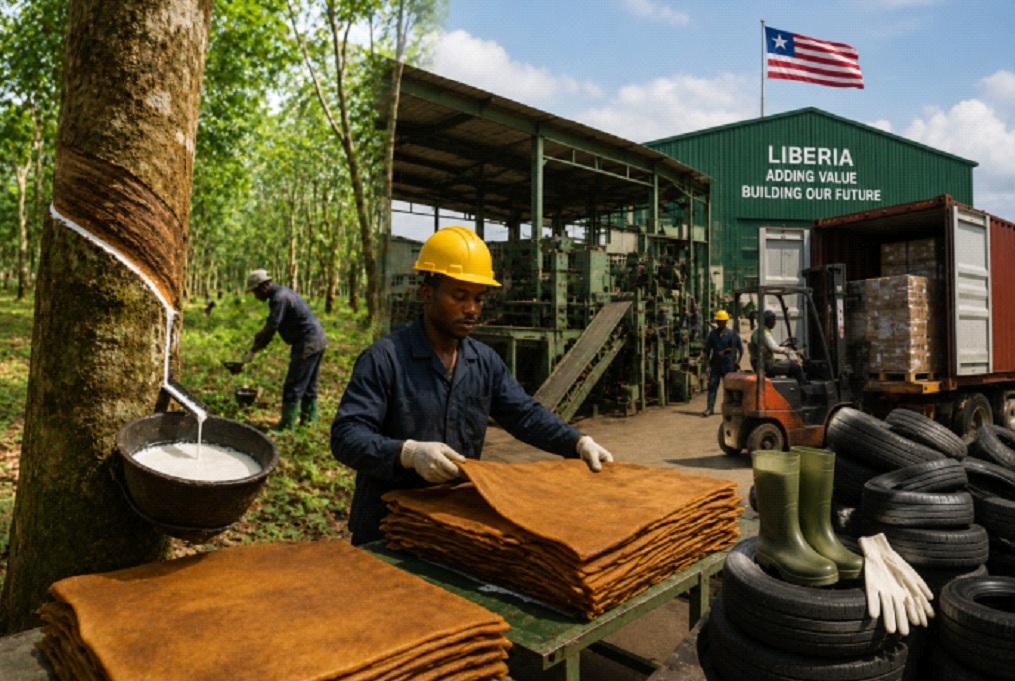
Liberia’s Rubber Export Ban Signals a Shift Toward Value Addition
President Joseph Nyuma Boakai’s Executive Order No. 151 prohibiting the export of unprocessed natural rubber from Liberia is a resource governance decision whose significance is best understood within the continental framework of beneficiation and value addition that has been reshaping how African governments approach their mineral and agricultural endowments. Liberia’s rubber sector has operated for decades under an export model whose logic is structurally familiar across Africa: extract or harvest the raw material, ship it to processing facilities outside the continent, and receive in return a price that captures only a fraction of the value the commodity generates along international supply chains. The executive order disrupts that logic by insisting that local processing precede export — that rubber must be transformed by Liberian workers in Liberian facilities before it leaves Liberian territory, capturing within the national economy a portion of the industrial value that has historically been captured elsewhere.
The policy’s developmental logic is reinforced by the structural critique of raw commodity export that African development economists have been articulating for decades: that primary commodity export concentrates price risk in the producing country while distributing processing margins and industrial employment to importing countries, creating a systematic transfer of value from resource-rich African economies to resource-importing industrial economies that is embedded in the structure of global supply chains rather than imposed through explicit extraction. By requiring domestic processing, Liberia is attempting to redirect some of that value — creating industrial linkages within the rubber sector, expanding employment along the value chain, and building the institutional and technical capacity that processing industries develop over time. The measure reflects a governing philosophy that treats natural resources not as assets to be liquidated through export but as foundations for industrial development.
Liberia’s rubber beneficiation policy joins a growing continental pattern — Zimbabwe’s lithium processing requirements, Tanzania’s mineral export restrictions, Lesotho and Botswana’s diamond beneficiation cooperation — that collectively signal a shift in how African governments are conceptualising their relationship to natural resources. Implementation challenges are real: building processing capacity requires investment, technical expertise, and regulatory frameworks that take time to develop, and export bans can generate short-term revenue disruptions before processing industries mature. But the direction is consequential. If African states can sustain the political will to enforce beneficiation requirements despite the commercial pressures that favour continued raw export, the cumulative effect across multiple commodities and multiple countries could meaningfully shift the terms on which Africa participates in global commodity value chains.





