
Namibia Advances $2.5 Billion Dangote Fuel Pipeline Project to Boost Regional Energy Security
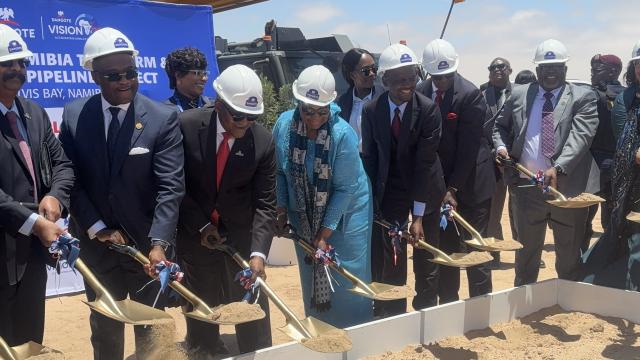
Namibia is advancing a major energy infrastructure investment with the launch of the $2.5 billion Dangote Namibia Tank Farm and Regional Pipeline Project in Walvis Bay. President Netumbo Nandi-Ndaitwah and Aliko Dangote launched the project on 4 November 2026. President Netumbo Nandi-Ndaitwah placed the project under the Office of the President to support effective coordination and implementation. The development includes a planned 600-million-litre petroleum storage facility. It will hold 360 million litres of diesel and 240 million litres of petrol. The project aims to strengthen Namibia’s fuel security and position Walvis Bay as a major regional energy and trade hub.
Beyond domestic fuel supply, Namibia aims to expand its role in Southern Africa’s energy distribution network. The project proposes a 1,700-kilometre pipeline connecting Walvis Bay to landlocked markets, including Botswana, Zambia, Zimbabwe, Malawi and the Democratic Republic of the Congo. NAMPA’s coverage of the project highlights its potential to reduce transportation costs and improve regional fuel distribution. Meanwhile, Mining and Energy Namibia reports on proposed pipeline connections towards Otjiwarongo, Rundu and Botswana. Developers must still complete engineering studies, route surveys and regulatory approvals before construction can proceed.
The investment could also create jobs and expand opportunities in Namibia’s logistics, construction, transport and trade sectors. It could attract further investment into Walvis Bay and strengthen the country’s position as a gateway to Southern African markets. For Namibia, the project represents an opportunity to move beyond its role as a fuel importer and become a strategic regional energy distribution centre. It also supports wider efforts to improve cross-border infrastructure, strengthen economic cooperation and advance regional integration. As implementation progresses, the project could help Namibia improve its energy resilience, support industrial development and deepen trade relations with neighbouring countries.





