
Niger Expands AES Biometric Identity Rollout
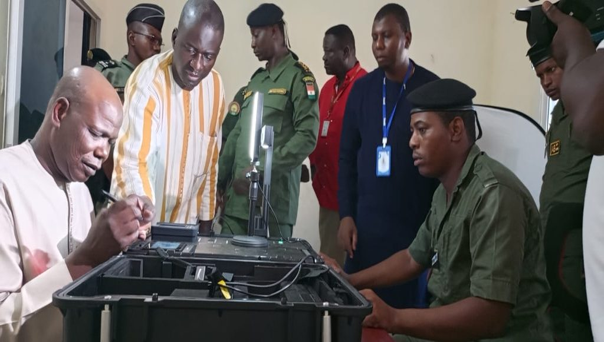
Niger has extended the rollout of the Alliance of Sahel States (AES) biometric national identity card to the Tillabéri region, marking another stage in the country’s effort to modernize citizen identification while giving practical form to the institutional integration of the Sahelian bloc. According to the Nigerien Press Agency (ANP), the enrollment operation was officially launched on October 5, 2026, at the Regional Directorate of the National Police in Tillabéri, where Regional Secretary-General Arma Yaou Maman became one of the first to undergo the registration process. The official described the initiative as an important step in modernizing legal identification in Niger and urged citizens to participate in the operation. The Tillabéri rollout follows the introduction of the card at the national level earlier this year, after President Abdourahamane Tiani was enrolled on March 27 and Prime Minister Ali Mahamane Lamine Zeine underwent enrollment in April, with the Nigerien government describing the system as part of efforts to strengthen identification, security and national sovereignty.
The expansion across Niger has gathered pace in recent weeks, demonstrating that the AES identity initiative is moving from central government implementation into the country’s regions. The ANP reported the launch in Tahoua on September 7, followed by Agadez on September 15, Zinder on September 22 and Diffa on September 29. The biometric document is designed with multiple security features, including fingerprints, facial photography, voice and iris data, and is available to citizens aged 15 and above. In Tillabéri, as in the other regions, applicants are required to provide civil-status and nationality documentation and proof of residence, while the reported enrollment fee is 4,500 CFA francs for the standard procedure and 9,000 CFA francs for the express service. The card has a five-year validity period, with the normal process taking several weeks and the express procedure allowing issuance within 72 hours. These developments build on the December 2025 decision by Niger’s Council of Ministers to establish the AES biometric national identity card, which the government linked explicitly to efforts by the AES states to harmonize identity and travel documents and facilitate the free movement of people within the Confederation.
The significance of the rollout therefore extends beyond the replacement of older identity documents. For Niger and the wider AES, the biometric card represents an attempt to translate regional political integration into practical administrative systems that citizens can encounter in their everyday lives. The December 2025 decision presented the card as part of a broader effort to harmonize documentation among the AES states, while Niger’s successive regional launches show the authorities moving toward nationwide implementation. The development also forms part of a wider institutional-building process within the AES, where Burkina Faso, Mali and Niger have increasingly sought to establish mechanisms reflecting their own priorities in security, administration, economic cooperation and regional mobility. With Tillabéri now joining Tahoua, Agadez, Zinder and Diffa in the rollout, Niger is steadily extending the AES identity framework beyond the capital and into its regions. The process consequently offers a concrete illustration of how the Sahelian bloc is seeking to move from political coordination toward functioning regional institutions, stronger administrative capacity and greater control over systems of identification and mobility.
PHOTO SOURCE: NIGERIEN PRESS AGENCY (ANP)
Author: Randy Lawson.





