
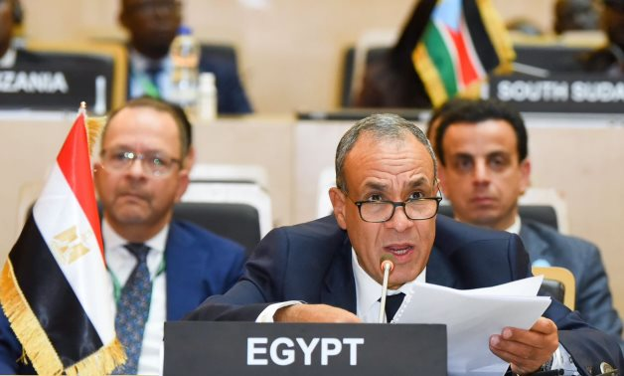
No Parallel States: Egypt and Djibouti Draw a Clear Line Around Sovereignty in the Horn
Egypt’s reiteration of its commitment to state sovereignty, territorial integrity, and its explicit rejection of ‘parallel entities‘ in the Horn of Africa — delivered during high-level talks between Foreign Minister Badr Abdelatty and Djibouti’s Foreign Minister Abdoulkader Houssein Omar in Cairo — carries the weight of a region under genuine institutional stress. The language of the statement is deliberately precise: it is not simply support for existing governments but a principled position against the emergence of alternative governing structures that operate outside recognised constitutional frameworks. In the context of the Horn of Africa’s current political landscape — where Somaliland’s bid for recognition, Ethiopia’s internal federal tensions, and Somalia’s contested state-building process are each producing pressures that test the established order — Cairo’s insistence on state-centric governance principles is a substantive contribution to regional stability rather than merely a diplomatic formality.
Beyond the political statement, the Cairo discussions revealed the practical architecture of what Egypt and Djibouti are building together. Both governments identified energy cooperation, maritime connectivity, logistics infrastructure, trade expansion, and technical assistance as priority areas for deepening bilateral engagement — a portfolio of economic cooperation that reflects Djibouti’s growing role as a commercial gateway for East African trade and Egypt’s interest in anchoring a network of strategic relationships along the Red Sea corridor. Minister Abdelatty’s specific mention of Egyptian private sector involvement in Djibouti’s economy signals an approach that goes beyond state-to-state cooperation toward productive commercial engagement — a relationship model in which economic interests sustain diplomatic commitments rather than merely accompanying them.
The meeting’s significance is embedded in its larger context. As geopolitical competition intensifies across the Red Sea and the Horn of Africa — with multiple external powers pursuing port agreements, security partnerships, and commercial relationships that reflect their own strategic calculations rather than regional stability — the ability of African states to coordinate around shared governance principles becomes increasingly consequential. Egypt and Djibouti are not simply exchanging diplomatic courtesies; they are reinforcing an architecture of state legitimacy and territorial integrity that has direct implications for how the region’s political conflicts are ultimately managed. For Pan-African advocates of state sovereignty and African-led peace processes, meetings like this — where regional states define their own governance standards without external prescription — are among the most important diplomatic work being done on the continent.





