
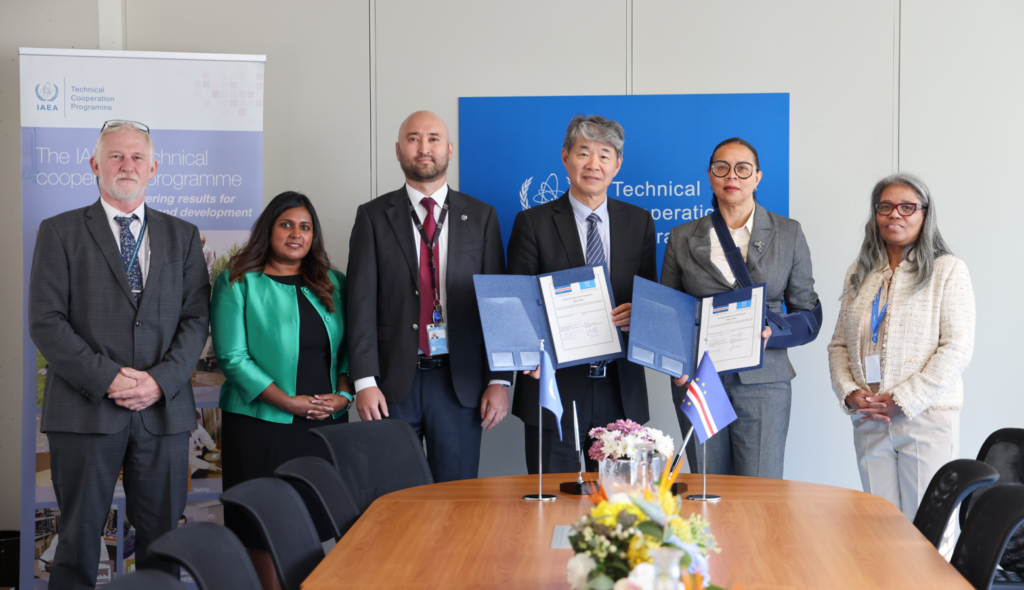
Strategic Development: Cabo Verde Signs Inaugural IAEA Country Programme Framework for 2026–2031
The Republic of Cabo Verde has formally established its first Country Programme Framework (CPF) with the International Atomic Energy Agency (IAEA), defining a strategic roadmap for technical cooperation and peaceful nuclear applications from 2026 through 2031. Primary reporting by the International Atomic Energy Agency (IAEA) details that the agreement was officially signed in Vienna on September 16, 2026, by IAEA Deputy Director General and Head of Technical Cooperation Hua Liu alongside H.E. Clara Manuela da Luz Delgado Jesus, Resident Representative of Cabo Verde to the IAEA. The foundational agreement serves as the official planning reference to align IAEA resource transfers, specialized training, and peaceful technology applications with the island nation’s medium-term socio-economic development goals.
Having officially joined the IAEA as a Member State in 2023, Cabo Verde’s inaugural framework prioritizes four core operational pillars: nuclear and radiation safety and nuclear security, food and agriculture, human health, and water resources management. Operational guidelines published by the IAEA Technical Cooperation Programme highlight that CPFs are explicitly structured to match national development blueprints, strengthening domestic institutional ownership and ensuring that radiation technology transfers deliver targeted, measurable impacts. For an archipelagic Small Island Developing State (SIDS), integrating isotopic techniques into groundwater mapping and agricultural resilience is increasingly vital for mitigating climate vulnerability, enhancing food security, and sustaining public health infrastructure.
The strategic partnership reflects a growing trend among African nations leveraging peaceful nuclear applications to tackle persistent environmental, hydrological, and healthcare challenges. Global developmental assessments documented by Devdiscourse demonstrate that African states are expanding multi-year technical cooperation frameworks to establish robust regulatory safeguards while applying nuclear techniques to marine conservation, disease diagnosis, and climate-resilient agriculture. By institutionalizing its 2026–2031 CPF, Cabo Verde secures essential technical expertise to modernise its regulatory infrastructure, optimize national water resource management, and reinforce sustainable sovereign growth.





