
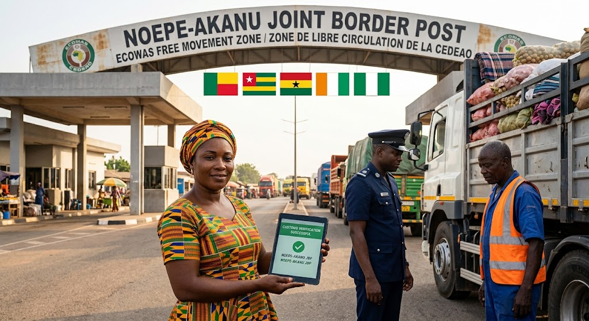
Tearing Down Border Barriers; ECOWAS Rallies Benin, Togo, and Ghana to Drive Seamless Trade Along the Abidjan-Lagos Corridor
The Economic Community of West African States (ECOWAS) has launched a direct, high-level operational push along the strategic Abidjan-Lagos Corridor, bringing border control authorities, transport unions, and cross-border commercial operators from Benin, Togo, and Ghana together at the Noepe-Akanu Joint Border Post to systematically dismantle persistent non-tariff barriers, eliminate extortion, and accelerate cross-border trade. Centered on translating long-standing Pan-African protocols into practical, everyday economic benefits for citizens, the tripartite intervention focuses heavily on streamlining operational procedures for women and youth entrepreneurs, who constitute the vast majority of informal cross-border traders across the Cotonou-Lomé-Accra economic axis. Extensive regional coverage published by THISDAY Live and field reports from CitiNewsroom emphasize that the Commission is prioritizing the full rollout of key regional mechanisms—including the ECOWAS National Biometric Identity Card (ENBIC), the digitized SIGMAT customs transit system, strict axle-load infrastructure controls, and joint border post harmonizations—to guarantee that regional integration delivers measurable cost reductions for merchants rather than remaining confined to policy documents.
For Benin’s commercial landscape, where maritime trade passing through the Port of Cotonou, agricultural logistics, and regional transit services form the lifeblood of national revenue, securing friction-free passage across neighboring borders is a direct prerequisite for economic expansion. For years, procedural bottlenecks, duplicate customs inspections, and arbitrary delays at border checks have artificially inflated transaction costs for Beninese traders importing and exporting goods across Togolese, Ghanaian, and Nigerian markets. As detailed in an in-depth economic analysis by NorvanReports, intra-ECOWAS trade currently hovers around a meager 11.5 percent of total regional commerce—a deficit driven not by formal tariffs, but by bureaucratic hurdles and unpredictable border environments. By establishing direct dialogues between enforcement agencies and the daily users of these international transit routes, the Noepe-Akanu initiative directly addresses these operational friction points, ensuring that Beninese businesses can move freight faster, lower supply chain overheads, and access larger consumer markets with greater predictability.
This renewed commitment to border efficiency serves as an indispensable pillar for West Africa’s long-term economic self-determination and regional stability under the African Continental Free Trade Area (AfCFTA) framework. Coupled with legislative momentum behind the planned 1,028-kilometer, six-lane supranational Abidjan-Lagos Corridor Highway, modernizing customs clearance and enforcing free-movement protocols demonstrates that sub-regional integration can yield immediate, tangible economic relief for ordinary citizens. Further reporting on the border engagements from ECOWAS News Online underscores that the ultimate benchmark of West African unity lies in transforming major transit corridors from regulatory chokepoints into dynamic, interconnected economic arteries that empower local enterprise and build true regional self-reliance.





