
The Architecture of Justice: Sierra Leone and the UN Chart a Course for Rights-Based Governance
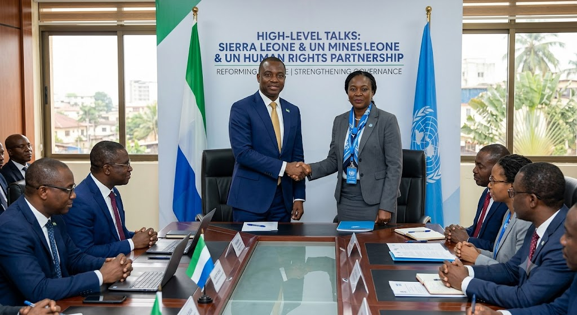
The high-level talks between Sierra Leone’s Attorney General and Minister of Justice Alpha Sesay and a delegation from the UN Office of the High Commissioner for Human Rights West Africa Regional Office reviewed a justice sector reform agenda whose breadth reflects the genuine scope of what meaningful governance transformation requires. The decriminalisation of poverty, the enhancement of human rights institutions, the reinforcement of the Human Rights Commission, and the constitutional review process designed to embed human rights principles more deeply into Sierra Leone’s legal framework are not isolated policy measures — they are components of a coherent vision of governance in which legal systems exist to protect the dignity and rights of citizens rather than to manage the inconvenience of their poverty or the political risk of their dissent. That Sierra Leone is pursuing this agenda in partnership with the OHCHR signals a commitment to external accountability for the commitments being made.
The decriminalisation of poverty deserves particular attention as a reform priority whose significance is both practical and philosophical. Across many legal systems, provisions that criminalise homelessness, petty informal trading, vagrancy, and other manifestations of economic exclusion function as mechanisms through which the state compounds the disadvantage of its most vulnerable citizens rather than addressing it. When poverty becomes legally punishable, the already limited dignity available to people living in it is further curtailed by the criminal justice system — producing not only injustice for individuals but a social message that the state regards those it has failed to protect from poverty as threats to be managed rather than citizens to be served. Sierra Leone’s commitment to dismantling that architecture is among the most consequential human rights reforms any government can undertake, because it changes not only specific laws but the fundamental relationship between the state and its poorest citizens.
The OHCHR’s reaffirmation of support through technical assistance, training, and long-term institutional strengthening situates Sierra Leone’s reform agenda within the wider framework of what effective governance transformation actually requires. Legal changes create the formal foundation; institutional capacity determines whether they are implemented; sustained technical cooperation builds the competence and systems through which implementation becomes consistent rather than episodic. Both parties’ acknowledgment of persistent challenges in institutional capacity and resource constraints reflects the kind of honest assessment that productive partnerships require — a recognition that the gap between the governance Sierra Leone aspires to and the governance it currently delivers is real, that closing it requires sustained investment in institutions rather than periodic declarations of intent, and that the credibility of the reform agenda depends on the quality of what it builds rather than the ambition of what it announces.





