
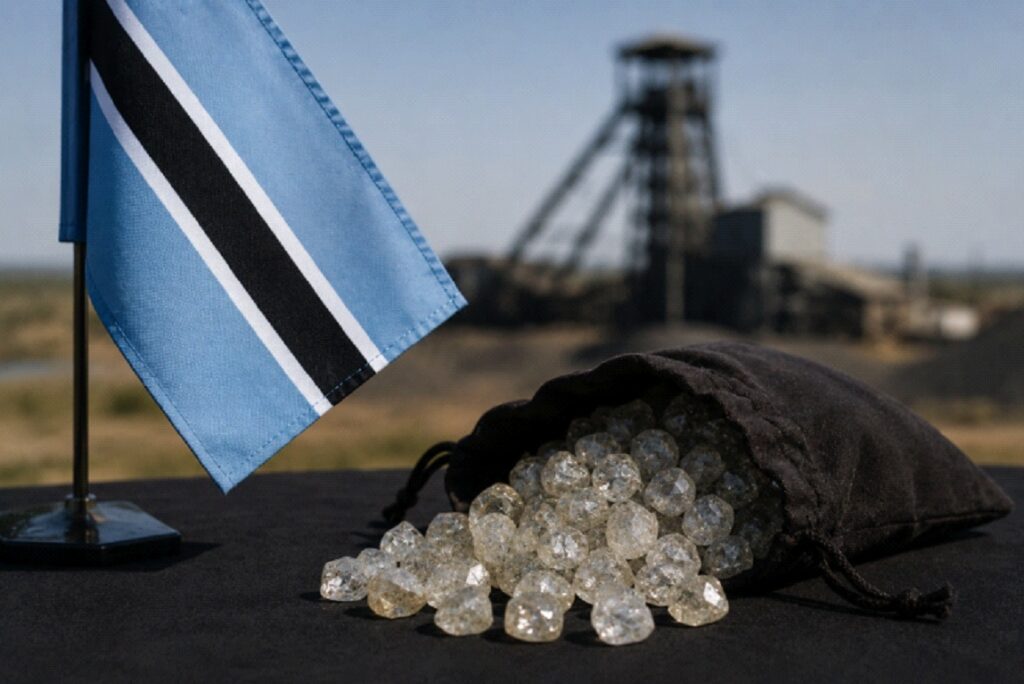
The Diamond Deal of the Century: Botswana’s Bid to Own the Industry That Built Its Nation
For more than half a century, Botswana has been the geological engine of the global diamond trade — supplying roughly 70 percent of De Beers’ rough stones — while holding only a 15 percent equity stake in the corporation that defined the industry’s terms of engagement. That asymmetry, which distilled in miniature the broader architecture of post-colonial resource extraction, is now approaching a decisive reckoning. Anglo American’s announcement that the sale of De Beers is a matter of weeks away has crystallised a negotiation carrying stakes that far exceed any ordinary corporate transaction. With De Beers’ book value slashed by 75 percent since 2022 to approximately $2.3 billion — the consequence of a halving in sales revenue, a collapse in Chinese luxury demand, and the structural disruption of lab-grown diamonds in American markets — Botswana is positioned to acquire majority ownership at a historic discount. President Duma Boko’s administration has made its intent clear: to cross the 50 percent ownership threshold that would transform Botswana from passive equity participant into active architect of how the world prices, markets, and distributes its most storied gemstone.
The consortium structures emerging from the bidding process reveal the complexity of what is, in effect, an act of macroeconomic self-determination at continental scale. Botswana is negotiating in alignment with Namibia and alongside Gulf sovereign wealth capital and industry veterans — while a parallel bid anchored by Angola’s state diamond producer Endiama has introduced competitive pressure while simultaneously opening conversations about regional coordination. The strategic logic for Botswana is not difficult to understand: diamonds account for roughly 80 percent of the country’s export earnings and approximately 30 percent of GDP. S&P’s sovereign credit downgrade following the diamond market’s prolonged slump underscored what that concentration costs when markets turn. Rather than retreat, the Boko government has characterised increased ownership as the logical instrument of diversification — seizing control of pricing mechanisms, sightholder allocation, and global marketing that have historically generated the industry’s highest margins in cities far removed from Botswana’s mines.
What unfolds here is not merely the restructuring of one corporation but a stress test of a model that has shaped Africa’s relationship with its own wealth for generations. The De Beers of 2026 is a company whose century-long stranglehold on diamond supply has been irrevocably disrupted by synthetic alternatives and whose controlling shareholder is eager to exit a sector whose future is genuinely uncertain. In that moment of institutional retreat, African producer states are stepping forward — not as supplicants but as sovereign bidders armed with geological leverage, patient capital partnerships, and a sharpened political will. If Botswana achieves majority ownership, it would represent the most consequential assertion of resource sovereignty by an African state in the post-independence era — a redefinition, finally and concretely, of who captures value from Africa’s earth, and on whose terms the terms themselves are set.


