Whose Fish, Whose Future? Comoros and Senegal Draw a Line Against Industrial Extraction
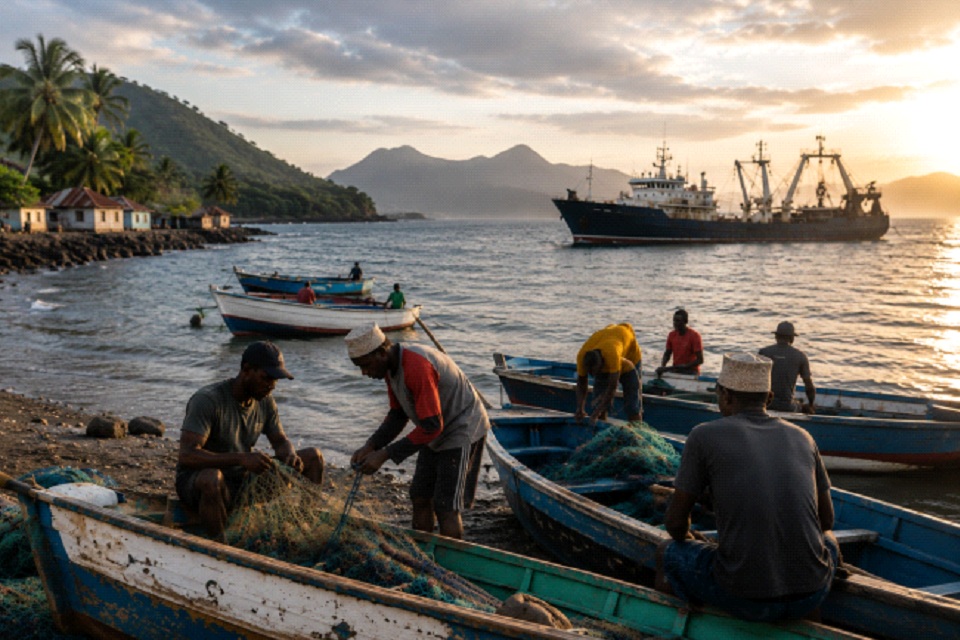
The commitment by Comoros and Senegal to exclude destructive industrial fishing activities from their coastal waters — announced at the 2026 Our Ocean Conference — represents more than a fisheries management decision. It is an act of resource sovereignty: a deliberate assertion that the marine wealth adjacent to their shores belongs first and most fundamentally to the communities that have lived from it for generations. For Comoros, where coastal livelihoods depend heavily on access to healthy nearshore ecosystems, the stakes are simultaneously economic, social, and existential. Artisanal fishing communities — whose boats, knowledge, and relationships with the sea are built over lifetimes rather than quarterly projections — cannot compete with the harvesting power of industrial fleets, and the depletion of nearshore stocks threatens not only income but food security, cultural continuity, and the social fabric of communities whose identity is inseparable from the ocean.
At the centre of the initiative is the question of who benefits from marine wealth — a question that echoes far beyond fisheries into the broader structure of African economic relationships with external interests. Across many African coastal regions, industrial fishing operations have historically possessed a technological and financial advantage over local fishers that translated directly into a competitive disadvantage for the communities whose proximity should, in principle, make them the primary beneficiaries of local marine resources. By seeking to limit destructive industrial activities in coastal zones, Comoros is advancing a governance model that prioritises local communities and sustainable resource use over the short-term extraction logic that industrial operators bring with them. The partnership with Senegal amplifies this position by creating a shared front between two distinct but complementary ocean economies — demonstrating that Pan-African cooperation can serve as both a moral and strategic resource for smaller states asserting their rights against larger external interests.
The significance of the initiative extends into the continental debate about decolonial resource governance and the practical meaning of economic sovereignty for small island and coastal states. Across Africa, calls for reform increasingly emphasise the need to reclaim greater control over natural resources and redesign governance systems around local participation, community benefit, and long-term ecological sustainability. The cooperation between Comoros and Senegal demonstrates how Pan-African solidarity can support these objectives by promoting shared approaches to common challenges — building the coalitions of the like-minded that have historically been more effective at pushing back against industrial extraction than any single state acting alone. In protecting artisanal fisheries and strengthening community access to marine resources, both countries are contributing to a vision of the blue economy in which Africa’s coastal wealth is governed in Africa’s interest and lived in Africa’s communities.