Climate Resilience Surge; Seychelles Launches $4.95 Million RESIslands Initiative to Strengthen Regional Early-Warning Infrastructure
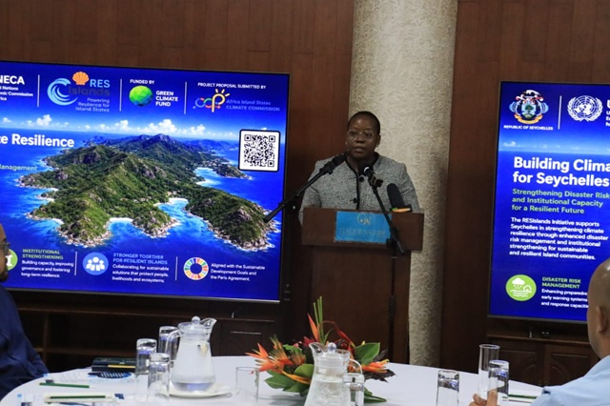
Seychelles has officially launched the national rollout of the $4.95 million RESIslands Project, a major multi-nation climate initiative designed to upgrade early-warning systems and enhance disaster risk management across African island nations. Formally introduced at Beau Vallon, the initiative—officially titled Strengthening the Institutional Capacities of the African Island States Climate Commission Member States to Manage Climate Risks and Bolster Resilience—is funded through a grant from the Green Climate Fund (GCF). Developed under the African Island States Climate Commission (AISCC) in partnership with the United Nations Economic Commission for Africa (UNECA), the program aims to address systemic vulnerabilities by standardizing climate risk data, upgrading institutional monitoring capacities, and building a robust pipeline to access long-term international climate finance.
Speaking at the launch ceremony, Minister for Environment, Climate, Energy and Natural Resources Marie-May Jeremie highlighted that for Small Island Developing States (SIDS), climate impacts such as rapid coastal erosion, erratic rainfall patterns, and sea-level rise are no longer future projections but daily operational realities. Jeremie emphasized that the RESIslands project will focus heavily on cross-institutional alignment, integrating data flows between the Department of Risk and Disaster Management, the Economic Planning Department, and the Seychelles Planning Authority. Technical bodies, including national meteorological services, maritime safety authorities, and the Islands Development Company (IDC), will also modernize their monitoring systems to deliver real-time, life-saving risk assessments—a capability critical for protecting isolated populations on Seychelles’ outer islands.
As detailed in coverage of the national rollout by the Seychelles News Agency, the initiative coincides with Seychelles holding the presidency of the AISCC. The commission, which represents nine island nations across the Atlantic and Indian Oceans, champions tailored adaptation strategies that address the unique structural exposures of island geography. Operational details published by the Green Climate Fund confirm that the RESIslands project forms part of a broader $34.3 million GCF portfolio in the archipelago, targeting ecosystem-based adaptation, coastal zone security, and sustainable infrastructure. By embedding these institutional early-warning frameworks, Seychelles aims to strengthen local community readiness while advancing the unified climate agenda of African island states on the global stage.