COUNTRY: SOMALIA.м
The escalating security crisis across the Sahel is forcing West Africa to confront a fundamental question: who should determine Africa’s security priorities, and what role should external powers play? Drawing from historical comparisons analyzed by ModernGhana, Somalia’s experience with foreign intervention offers critical lessons for the Sahel and coastal states like Ghana. While the two regions are distinct, Somalia’s history illustrates the grave risks of relying primarily on foreign military intervention to solve complex internal political crises. A notable turning point was the controversial 12 July 1993 U.S. strike in Mogadishu—which killed dozens during a meeting of elders and militia figures. Rather than resolving the conflict, the operation alienated local communities, hardened anti-UN sentiment, and consolidated opposition power, proving that military action without political alignment often deepens local instability.
This lesson is directly applicable to the Sahel, where crisis stems not only from armed groups, but from governance gaps, economic exclusion, and eroded state legitimacy. In response, Burkina Faso, Mali, and Niger have actively distanced themselves from traditional Western military partnerships, seeking alternative security frameworks. This shift impacts neighboring coastal nations like Ghana, where national discussions—highlighted by the
Ghana News Agency—focus heavily on preparedness against northern border spillover. Simultaneously, international arrangements provide essential technical, intelligence, and logistical support. However, these initiatives highlight an ongoing dilemma: while international aid addresses immediate operational deficits, it risks entrenching a structural dependency that undermines long-term national sovereignty.
Somalia’s current security reality underscores the double-edged nature of foreign assistance. The country remains heavily reliant on external backing. This demonstrates that while external involvement can foster long-term dependency, abruptly cutting it off before local institutions are ready can trigger catastrophic collapse. The core challenge for African states is not simply to accept or reject foreign help, but to ensure that international partnerships actively build self-sustaining national and regional capabilities rather than replacing them permanently.
Achieving true strategic autonomy requires operationalizing continental mechanisms like the African Peace and Security Architecture (APSA) and the African Union Peace Fund (outlined by the
African Union). Historically, African-led peace operations have faltered due to a lack of independent financing and logistical infrastructure. If African nations wish to dictate their own security directives, member states must financially commit to these mechanisms. Furthermore, as community initiatives in Bolgatanga—reported by
EEAS Gulf of Guinea—demonstrate, sustainable security relies on civil trust, social cohesion, and local participation just as much as military capability. A purely martial response treats symptoms while ignoring the socioeconomic roots of conflict.
Ultimately, the lesson from Mogadishu is not that Africa should isolate itself from global partners, but that African security must be directed by African priorities, sustained by African institutions, and accountable to African peoples. Political independence without financial and operational security capacity leaves national sovereignty vulnerable. West African states must bridge diplomatic divides—such as those between ECOWAS and the Alliance of Sahel States—to maintain cross-border intelligence sharing and joint prevention. External partnerships can supply valuable resources, but the ultimate objective must remain a self-reliant continent capable of defining, funding, and defending its own peace and strategic interests.
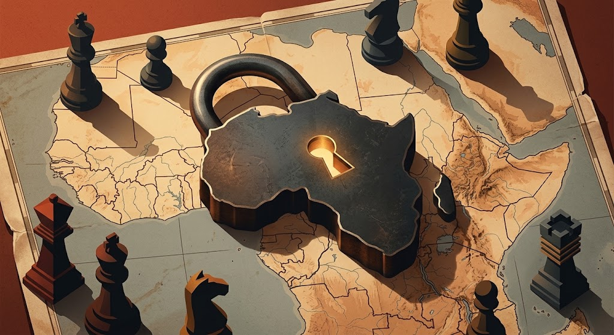
PHOTO SOURCE: AI GENERATED
Author: Randy Lawson.