Trade as Statecraft: Libya’s Indian Investment Talks Signal a Country Reclaiming Its Economic Sovereignty From the Ground Up
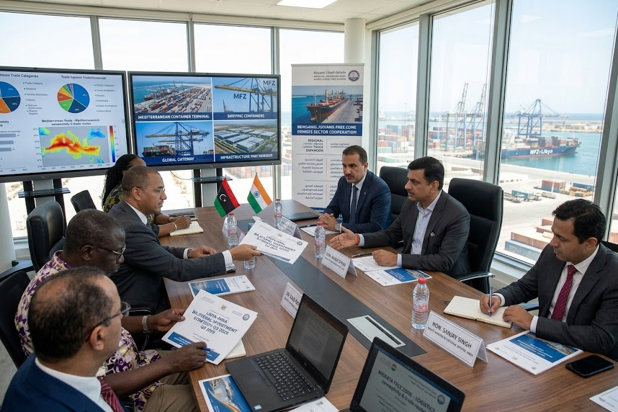
An Indian trade delegation’s four-day engagement with Libya’s key economic institutions — spanning the Misrata Free Zone, the Libyan Business Council, and Benghazi’s Julyana Free Zone Port — is a bilateral economic encounter whose significance is most clearly visible in its geographic breadth: meetings in both western and eastern Libya reflect a deliberate effort to engage the country’s economic geography comprehensively rather than concentrating partnership discussions in a single political or commercial centre. For Libya, a country whose reconstruction and economic stabilisation agenda has been complicated by years of political fragmentation, the ability to attract a high-level trade delegation willing to engage across multiple regions is itself an institutional statement — that the country’s economic institutions are functional enough, and its investment environment sufficiently credible, to warrant serious commercial engagement from a major emerging economy.
The Misrata Free Zone’s presentation of its infrastructure, digital capabilities, and strategic logistics positioning to the Indian delegation reflects a governing philosophy whose developmental logic is straightforward: that free zones capable of attracting international investment, facilitating technology transfer, and hosting diversified industrial and commercial activity can serve as anchors for broader national economic development even in contexts where the surrounding political environment remains complex. India’s existing commercial presence in Libya — and the delegation’s expressed willingness to facilitate visa processes for Libyan businesses seeking engagement with Indian markets — signals a relationship whose commercial depth is growing alongside the diplomatic formalities that typically precede it. Benghazi’s Julyana Free Zone Port discussions on investment, port development, and private sector cooperation add an eastern dimension that gives the engagement genuine national scope.
Libya’s Indian investment outreach is part of a broader economic diplomacy strategy whose Pan-African significance lies in what it models for resource-rich countries rebuilding from conflict: that the deliberate cultivation of diversified international economic partnerships — engaging partners from South Asia, the Gulf, Europe, and Africa simultaneously rather than depending on any single external relationship — is both a commercial strategy and a sovereignty strategy. Dependence on a narrow set of external economic relationships creates leverage for those partners that genuinely independent economic governance cannot sustain. Libya’s effort to position its ports, free zones, and private sector as gateways for regional and global trade is therefore not only an investment attraction exercise but a claim about the kind of economic actor Libya intends to be — one that governs its own economic relationships rather than having them governed by others.